Can I donate bone marrow?
Who qualifies, what disqualifies you, and the truth about the male-only donor myth.
Read more

Scientifically accurate, age-appropriate educational content about blood and bone marrow donation for Washington State classrooms and beyond.
Last updated
Supporting Washington State RCW 28A.210.430
This content supports the blood and bone marrow donation awareness instruction that Washington school districts are encouraged to offer beginning in the 2025-26 school year.
A chance at cure can come down to finding one person. Scroll through what leukemia does to the marrow, what a transplant asks of a body, and why the search ends with markers you inherited before you were born.
It is the story of Jada, who was diagnosed at one month old and had no match in her family — told the way it actually happens.
Or read the plain explanations: 147 condition guides, from leukemia to rare inherited disorders.
Educational and sourced: written and source-checked by the Foundation. Every figure in the story carries the population and year it came from.
Understanding the public health importance of blood and bone marrow donation.
Blood has a limited shelf life and must be continuously replenished.
Source: American Red Cross
A small percentage of eligible donors support the entire healthcare system.
Source: American Red Cross
Most patients who need a bone marrow transplant do not have a fully matched donor in their own family.
Source: NMDP
Patients from diverse ethnic backgrounds face significantly greater challenges finding donors.
Source: NMDP, 2024
Bone marrow and blood stem cell transplants require careful matching between donors and patients. Unlike blood transfusions, which match blood types, marrow transplants require matching human leukocyte antigen (HLA) markers—inherited genetic traits that vary significantly across populations.
Registries maintain databases of potential donors who have been tissue-typed. When a patient needs a transplant, doctors search these registries for compatible donors. The more people registered, and the more diverse the registry, the better chance every patient has of finding a match.
Age-appropriate explanations of the science behind blood and bone marrow.
Blood is a living tissue that flows through our bodies, carrying everything our cells need to survive. An average adult has about 10 pints of blood (Source: NIH NHLBI).
Red blood cells carry oxygen from our lungs to every part of our body and bring carbon dioxide back to be exhaled.
White blood cells are part of our immune system, fighting infections and keeping us healthy.
Platelets help our blood clot when we get a cut, stopping bleeding and starting the healing process.
Plasma is the liquid part of blood that carries nutrients, hormones, and proteins throughout the body.
Bone marrow is the soft, spongy tissue found inside our larger bones. Think of it as a factory that produces blood cells.
Blood stem cells (also called hematopoietic stem cells) live in the bone marrow. These special cells can develop into any type of blood cell the body needs.
Every day, bone marrow produces billions of new blood cells to replace old ones that have worn out. This continuous process keeps our blood healthy and our bodies functioning.
When bone marrow does not work properly—due to diseases like leukemia or other conditions—patients may need healthy stem cells from a donor to rebuild their ability to make blood.
Our bodies are remarkably good at maintaining balance—a process scientists call homeostasis. When we donate blood, the body immediately begins replenishing what was given.
Plasma is replaced within hours. Red blood cells take a few weeks to fully regenerate. This is why there are waiting periods between blood donations—to give the body time to recover completely.
Similarly, when blood stem cells are collected from a donor, the body's bone marrow naturally produces new stem cells to replace them. Most donors feel back to normal within a few days to a couple of weeks.
This natural recovery process is why healthy adults can safely donate—the body is designed to regenerate what it shares.
A donor registry is a database of people who have volunteered to potentially donate blood stem cells or bone marrow if they match a patient in need. Registries operate in many countries and cooperate internationally to find matches for patients worldwide.
Unlike blood type matching, bone marrow matching requires compatibility of HLA (human leukocyte antigen) markers. There are millions of possible HLA combinations, and the best matches typically share ancestry. This is why patients of diverse ethnic backgrounds often have more difficulty finding matches—they need more donors from similar backgrounds to be registered.
HLA types are inherited from parents, much like eye color or blood type. People who share ethnic or ancestral backgrounds are more likely to have similar HLA markers. This genetic reality means that building a diverse registry is essential for serving all patients equitably.
Young people cannot register as donors until they reach their registry's minimum age (in the United States, NMDP registers new members aged 18 to 35; other countries set their own ranges). However, learning about donation early helps future adults make informed decisions. Understanding the science and importance of donation is the first step—actual registration decisions come later, when individuals are eligible and can give informed consent.
Addressing common misconceptions about blood and bone marrow donation.
Bone marrow donation always requires surgery.
NMDP, the U.S. registry, says about 90% of its donors give through a non-surgical process called peripheral blood stem cell (PBSC) collection, similar to donating blood platelets (Source: NMDP, formerly Be The Match).
Donating blood or bone marrow is dangerous.
Donation procedures are carefully regulated and monitored. Donors undergo health screenings, and the body naturally replenishes what is donated.
Learning about donation means you have to donate.
Education is about understanding, not obligation. Donation is always voluntary, and individuals make their own informed decisions when they are eligible adults.
Only certain people can help patients who need transplants.
People of all backgrounds can potentially help. In fact, patients from diverse ethnic backgrounds especially need more donors who share their ancestry.
There are already enough donors on the registry.
More than 9 million people are on the U.S. NMDP Registry, and more than 40 million potential donors can be searched worldwide, yet patients from diverse backgrounds still face significantly lower match rates than white patients (Source: NMDP, 2024). More registrants are always needed.
Honest, sourced answers to the questions people actually ask before they join the registry — about who can donate, what the procedure is like, and how recovery goes. Most fears about being "disqualified" turn out to be unfounded.
Explore conditions, treatments and the role of blood stem cell transplantation. Search by name, abbreviation or an earlier diagnosis name, with sources linked on every page.
Learn when a transplant may use a donor and when it uses the person’s own cells.
Who qualifies, what disqualifies you, and the truth about the male-only donor myth.
Most controlled conditions don't disqualify you — the registry decides from your full health history.
A healed tattoo does not disqualify you — only very recent ink may need a short wait.
Well-managed type 2 is often fine; insulin-dependent is more often deferred — so don't rule yourself out.
Controlled blood pressure usually doesn't disqualify you — and BP medication is fine.
Antidepressants, statins, birth control and thyroid pills generally don't rule you out.
Weight alone rarely disqualifies you — any BMI guideline is about donor safety, not size.
Most "I think I'm disqualified" fears are wrong — the real hard-no list is short.

NMDP recruits eligible U.S. residents ages 18–35; join and stay-on rules vary by registry.
The honest pain level, the recovery, and the real risks of donating.
The two ways to donate — PBSC and marrow — explained step by step.
Most PBSC donors are back to normal within a week — the body regenerates what you give.
A full sibling has only about a 1-in-4 chance of matching — which is why strangers matter.
Why bone marrow matching depends on HLA markers, not blood type.
Whether donors are paid, what's covered, and why the system works that way.
How to pick the right registry for your country and sign up.
Look up where you live in an A–Z of every country and territory, and see how joining works there.
Steps to Marrow is our foundation's signature awareness program. Since 2009, founder Jeana Moore has walked thousands of miles across the United States and internationally, stopping in communities to share information about bone marrow donation.
Why walking works: Walking through communities creates natural opportunities for conversation. People stop to ask questions, share stories, and learn. This personal, unhurried approach helps spread awareness without pressure.
A model, not a requirement: Steps to Marrow demonstrates one way communities can engage in health awareness. Educators can discuss this as an example of civic engagement and creative approaches to public health education.
Ready-to-teach lessons for every grade band — key concepts, vocabulary, discussion questions, and printables. Free to use in any classroom, in any English-speaking school, anywhere in the world.
"Who are the helpers in your community? How do people help each other stay healthy?"
"Why is blood important for our bodies? What happens when someone loses a lot of blood?"
"Why might it be harder for some patients to find a matching donor than others?"
"How do individual choices affect community health outcomes? What role does diversity play in donation registries?"
Foundation founder Jeana Moore has authored several books to help young readers understand bone marrow donation in age-appropriate ways.
A Journey Across America
The heartfelt story of Jeana's journey walking across America to raise awareness for bone marrow donation. This book shares the inspiring tale of love, determination, and hope as Jeana walks thousands of miles in honor of her granddaughter Jada, touching communities and lives along the way.
A European Journey of Hope
Follow the inspiring journey through Germany, Italy, and Switzerland—a walk that spread awareness and connected communities across borders. This book captures the international spirit of the mission, as Jeana continues to honor Torsten and Jada while building bridges between cultures.
We are here to support your classroom instruction. Request a speaker, ask about educational resources, or connect with us about how we can help.
Primary references for the statistics and claims on this page. The Jada Bascom Foundation cites these organizations as authoritative sources; this is not a formal partnership relationship.
Educational Disclaimer: This content is intended for educational awareness purposes only and does not constitute medical advice. Information about donation processes is provided for general understanding. Actual donation eligibility is determined by registries and medical professionals. Students should direct health questions to qualified healthcare providers.
The Jada Bascom Foundation is a 501(c)(3) nonprofit organization. We do not encourage minors to register as donors. Our educational content supports informed decision-making by future adults.
Joining a registry can make you available as a potential match for a patient who needs a transplant. JBF helps you find the official registry that serves your country.
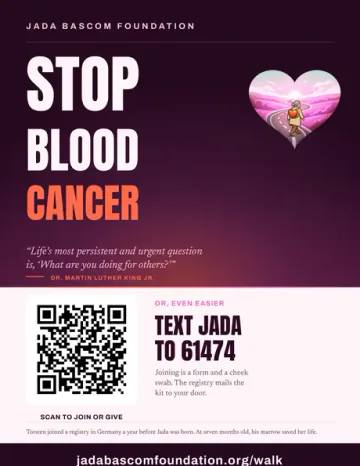
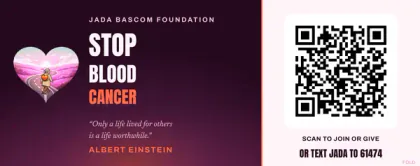
Take it off the screen
A coffee counter, a church foyer, a break room, a race table. Every sheet carries the code that opens Jeana’s walk, and a number to text for anyone who would rather not scan — no app, no wifi, nothing to hand back.Every sheet carries the code that opens Jeana’s walk — nothing to install, nothing to hand back. The number to text printed beside it is for joining NMDP, which registers people who live in the U.S., its territories and the freely associated states. If you live anywhere else, find your country’s registry.
Flyer
One page, for a wall or a noticeboard. The same sheet in three voices.
Table tent
One page that folds and stands on a table or a counter.
Everything else for running a drive
Host a registration drive at your school, work or place of worship, raise funds, or lend a skill. Tell us what you have in mind and we will help you plan it.