What is HLA matching?
HLA matching compares inherited immune-system markers to measure donor-patient compatibility. Official registries arrange typing, and clinical teams evaluate and select the donor match.
Many registries use a cheek swab • The registry performs HLA typing • Keep your registry profile current
Last updated
HLA in 30 seconds
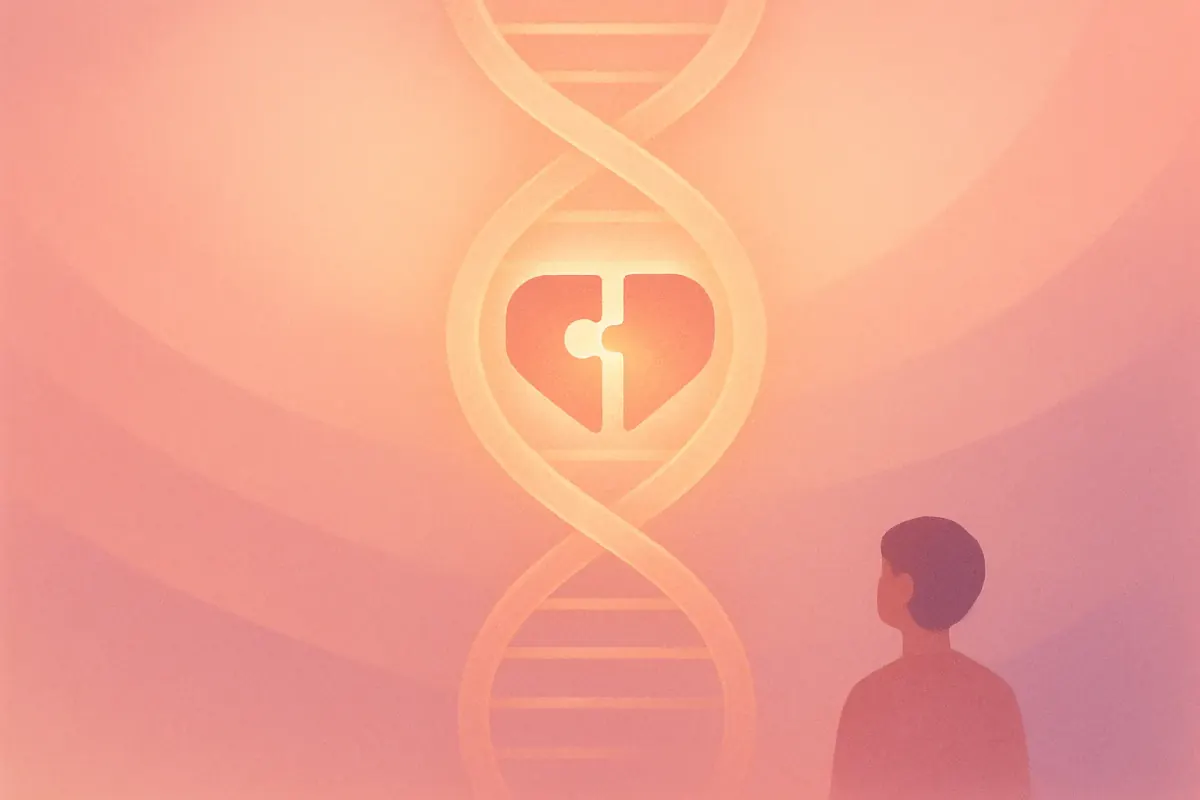
HLA stands for Human Leukocyte Antigen. These are proteins on the surface of nearly every cell in your body that act as ID markers — they tell your immune system that a cell belongs to you. Your HLA type is set by your genes, and you inherit half of it from each parent.
In a bone marrow transplant, doctors match the donor’s HLA type to the patient’s so that the donated cells — which become the patient’s new immune system — do not attack the patient’s body, and the patient’s body does not attack the donated cells. A close match is called an HLA-matched donor.
HLA matching is a genetic compatibility test. Official registries and clinical teams arrange the sampling, typing, and matching. Many registries use a cheek swab, while others may use a different process. A lab reads specific HLA markers in your DNA and compares them against patients waiting for a donor. The National Cancer Institute describes HLA matching as testing tissue for the antigens that make up a person’s tissue type.
Many registries use a cheek swab • The registry performs HLA typing • Keep your registry profile current
The science of HLA matching
The HLA genes sit on chromosome 6, in a region called the Major Histocompatibility Complex (MHC). Six HLA proteins matter most for transplantation: A, B, C, DR, DQ, and DP. Together they form the profile a transplant team reads when looking for a donor.

You carry two complete sets of these proteins — one inherited from each parent. The HLA type used in matching is that combined profile. Because it is inherited as a set, your full siblings have a 1-in-4 chance of matching you across the board, while an unrelated match is far rarer.
Each HLA gene comes in a large number of variants, called alleles, and the catalogue keeps growing as more are sequenced. The authoritative count is maintained by the IPD-IMGT/HLA database, which lists more than 44,775 HLA alleles as of IPD-IMGT/HLA database release 3.64, 2026. That enormous diversity is exactly why a specific patient’s set of markers can be so hard to match.
Your full HLA profile is shared with some other people, but for any one patient the universe of truly compatible donors is small. This is the core reason registries need millions of members rather than thousands. Fred Hutchinson Cancer Center, where modern bone marrow transplantation was pioneered, explains how this HLA matching underpins the search for an unrelated donor.
For a transplant, HLA matching is usually evaluated at 8 or 10 specific markers. A 10/10 match means all ten agree. An 8/10 match has two mismatches — still potentially usable, but with a higher risk of complications. The National Cancer Institute defines the human leukocyte antigens these markers represent.
Why finding a match is hard — and why diversity in the registry matters
HLA types are inherited from your ancestors. Populations that were separated by geography for thousands of years developed different HLA patterns, so a person of European ancestry is more likely to match other people of European ancestry, and the same holds for African, Asian, and mixed ancestry.
The US registry has historically over-represented white European Americans. As a result, a patient of color in the US has a meaningfully lower probability of finding a fully matched donor than a white patient, and patients with mixed ancestry face the longest odds because their profile is rare in any single population.
The gap is real and measurable. Published analyses of the US registry — including a study of HLA match likelihoods in the New England Journal of Medicine (Gragert et al., 2014) and outcomes data from the HRSA C.W. Bill Young Cell Transplantation Program — show white patients finding a fully matched unrelated donor at the highest rate, roughly 75 to 80 percent. The rate is materially lower for patients of color: Black or African American patients face the longest odds, with published estimates around 30 percent or lower, and Hispanic and Asian patients fall in between.
The fix is diversity in the registry. Each new member from an underrepresented community measurably raises the chance that future patients from that community will find a match. That is the scientific reason representation on the registry is a matter of life and death, explained more fully on the donors of color page.
What HLA typing actually involves
At registration: Your registry will explain its enrollment and HLA-typing process. Many registries use a cheek swab; some use another sampling method or an in-person process.
The official registry owns this step. It confirms eligibility, arranges sampling, performs or coordinates HLA typing, and maintains the donor profile.
If you are called: more detailed HLA testing, usually from a blood sample, confirms the match at higher resolution before anything else happens. This confirmatory typing reads your HLA genes at finer detail than the initial swab, because the closer the resolution, the more confident the transplant team can be that the markers truly agree.
Many registries use a cheek swab • The registry performs HLA typing • Keep your registry profile current
What a match means for the patient
A 10/10 HLA match minimizes the risk of graft-versus-host disease (GVHD), a condition in which the donor’s immune cells, carried in the transplant, attack the recipient’s body. The closer the match, the lower that risk tends to be. GVHD matters because the donated cells go on to become the patient’s new immune system, so the better the HLA markers agree, the less likely those new cells are to treat the patient’s own tissue as foreign.
Even with a perfect HLA match, GVHD can still occur. Matching reduces the risk rather than eliminating it, and modern transplant protocols use medications and conditioning regimens to manage it. Memorial Sloan Kettering Cancer Center describes how its bone marrow and stem cell transplant teams weigh match quality against these risks.
Some transplants use haploidentical matching, where only half the HLA markers match — typically from a parent or child. Advances in transplant protocols have made this increasingly viable, expanding options for patients who cannot find a fully matched donor. Cord blood transplants, which use stem cells from donated umbilical cord blood, require less stringent HLA matching and provide another option, as the Dana-Farber stem cell transplant program explains.
Frequently asked questions
What is HLA matching?
HLA matching is a genetic compatibility test that determines whether a bone marrow donor’s cells will work in a specific patient without immune rejection. The lab compares specific HLA markers in the donor’s DNA against the patient’s, because the donated cells will become the patient’s new immune system.
What does HLA stand for?
HLA stands for Human Leukocyte Antigen. These are proteins on the surface of nearly every cell in the body that the immune system reads as markers of "self," which is why the National Cancer Institute describes them as the molecules that make up a person’s tissue type.
How is HLA typing done?
Official registries and clinical teams perform HLA typing. Many registries begin with a cheek swab, while others use a different sampling process. A lab analyzes HLA markers, and confirmatory testing later in the process often uses blood.
How many HLA markers are checked for transplant?
Usually 8 or 10 markers are evaluated — the HLA-A, B, C, and DR genes, and sometimes DQ and DP. Each marker comes in two copies, one inherited from each parent, which is why matching is scored out of 8 or out of 10.
What is a 10/10 match?
A 10/10 match means all 10 evaluated HLA markers agree between donor and patient. It is the preferred standard for an unrelated transplant because it gives the lowest risk of immune complications such as graft-versus-host disease.
Can you have multiple HLA matches?
Yes. More than one person on the registry can match the same patient at the same HLA markers. When that happens, the transplant team weighs other factors such as donor age and health to choose the best available donor.
Why does ethnic background affect matching?
HLA types are inherited and vary across genetic populations that were separated by geography for thousands of years. Patients are therefore most likely to match donors from a similar ancestry, which is why a registry needs members from every community to serve every patient.
Do you have to be a perfect match to donate?
A 10/10 match is preferred, but it is not the only option. Modern transplant protocols also use 9/10 matches and haploidentical (half-matched) transplants from a parent or child, and cord blood transplants tolerate more mismatch, so the donor pool is wider than a perfect match alone.
How long does HLA typing take?
Timing varies by registry, lab, and stage of the match process. Your official registry explains its initial sampling timeline and any confirmatory testing if you are later identified as a possible match.
Can family members be HLA matches?
Yes, and family is checked first. Because HLA is inherited as a set, full siblings have about a 1-in-4 chance of being a full match. Parents and children share half of your HLA markers. Even so, most patients do not have a fully matched relative, which is why unrelated registry donors are needed for the majority of transplants.
Does my HLA type ever change?
Your inherited HLA genes do not change over your lifetime. Registry records still need current contact and health information, so keep your profile updated and follow the registry’s instructions if it requests another sample or confirmatory testing.
What is a haploidentical match?
A haploidentical, or half-matched, transplant uses a donor who matches at only half of the HLA markers — typically a parent, child, or some siblings, since each shares one set of HLA genes with the patient. Advances in transplant protocols have made these increasingly viable, expanding options for patients who cannot find a fully matched donor.
What to do next
Now that the science is clear, here is where most people go next.
- Curious if you qualify? Can I donate bone marrow?
- Could a brother or sister match? Understand sibling match odds
- Why does diversity in the registry matter? Why donors of color are urgently needed
- Ready to register? How to find your bone marrow registry
- Not sure where to sign up? Which registry should you join?
You now understand what HLA matching is and why your profile matters. Your registry will explain its enrollment and HLA-typing process, then keep the information needed to contact you if you may match a patient.

Many registries use a cheek swab • The registry performs HLA typing • Keep your registry profile current