Why donors of color are urgently needed
Bone marrow patients of color face dramatically lower match rates than white patients. The science is in HLA inheritance — and the fix is more registered donors from every community.
The official registry serving your country sets its enrollment method, timing, cost, sample collection, and any kit or mailing instructions.
Last updated
The match-rate gap
The chance of finding a fully matched unrelated donor is not the same for every patient. Published analyses of the US registry, including NMDP registry data summarized in Cells (Devine, 2024) and a study of match likelihoods in the New England Journal of Medicine (Gragert et al., 2014), describe a wide gap by ancestry:
- White patients find a fully matched donor at the highest rate, roughly 75 to 80 percent.
- Black patients face the longest odds, with published estimates around 30 percent or lower.
- Hispanic and Asian patients fall in between those two ends.
- Multiracial patients can face especially narrow searches, because their combination of HLA markers may be uncommon in any single population’s pool.
The difference between an 80 percent chance and a 30 percent chance is measured in lives. Patients without a matched donor face harder treatment paths and worse survival odds. The gap is not inherent to the disease — it is a function of how the registry was built.
The official registry serving your country sets its enrollment method, timing, cost, sample collection, and any kit or mailing instructions.
The science behind the gap
HLA proteins are inherited and vary across populations that were historically separated by geography. A person of European ancestry is more likely to find a match among other people of European ancestry, and the same pattern holds for African, Asian, and mixed ancestry. The National Cancer Institute explains how this inherited compatibility governs whether a transplant can proceed.
The HLA genes sit close together on chromosome 6 and are usually inherited as a linked set, called a haplotype, from each parent. Because these sets are passed down largely intact, the specific combinations that are common in one ancestral population can be uncommon or absent in another. African ancestral populations in particular carry a wide range of HLA haplotypes, which means more donors are needed to cover the same proportion of patients than in populations with less varied profiles.
The US registry developed with disproportionate white European representation. That was not due to malice; it reflects where recruitment drives were held, who was reached, and how outreach evolved over the decades since the registry’s founding in the 1980s. The structural result is a registry that serves some populations far better than others.
The math points to a remedy. Every new registration from a community currently underrepresented in the registry raises the match probability for future patients from that community, and the effect is measurable. For the full science of how matching works, see What is HLA matching?
What this means for each community
Black and African American donors
Black patients face the largest match gap in the US registry, with published estimates of finding a fully matched unrelated donor around 30 percent or lower. The cause is the shortfall of donors of African ancestry on the registry, not anything about the patients themselves.
Sickle cell disease also disproportionately affects Black Americans, and a bone marrow transplant is one of the few potentially curative options for severe disease, though it is a serious treatment decision made by a patient’s clinical team. The National Heart, Lung, and Blood Institute describes the condition and its treatment.
National registries run community-specific recruitment efforts for African American donors, and faith-community drives and drives at historically Black colleges and universities (HBCUs) have long been significant channels. Registration through any national registry counts toward closing the gap.
Hispanic and Latino donors
Hispanic and Latino patients find a fully matched donor at a rate well below that of white patients. The broad category also hides wide variation: people of Mexican, Puerto Rican, Cuban, Dominican, and Salvadoran heritage, among others, carry distinct HLA distributions, so a patient of Puerto Rican heritage benefits most from donors of Puerto Rican heritage specifically.
The Icla da Silva Foundation, the largest Hispanic-focused recruitment organization in the US registry network, has long run community drives at cultural organizations, churches, and Latino-focused workplaces. Registration through any national registry adds to the same pool.
Asian and Pacific Islander donors
Asian American and Pacific Islander (AAPI) patients also find matches at lower rates than white patients. The AAPI category spans East Asian, Southeast Asian, South Asian, and Pacific Islander populations, each with distinct HLA distributions, and Pacific Islander representation on the registry is especially low.
The Asian American Donor Program (AADP) has long run recruitment across these communities, with college AAPI organizations, cultural associations, and faith communities serving as frequent drive hosts. Registration through any national registry counts.
Multiracial and mixed-race donors
Multiracial patients can face a narrow search, because an HLA profile drawn from more than one population may be uncommon in any single population’s pool. For the same reason, multiracial donors are especially valuable: one profile may match across several populations.
Multiracial people are also among the fastest-growing groups in the US, and registry representation has not kept pace. Registering as a multiracial donor measurably benefits future multiracial patients who would otherwise have very few options.
Indigenous and Native donors
Indigenous and Native communities are severely underrepresented on the registry. The terms are related but distinct: Native American refers to the Indigenous peoples of the continental US, Indigenous is a global category, and Native Hawaiian and Alaska Native are separate groups often counted under the Indigenous heading in US data.
Because the registry holds so few donors from these communities, patients have among the fewest matched-donor options of any group. Recruitment happens through tribal communities, urban Native organizations, and Native student associations at colleges. Registration through any national registry counts toward closing that gap.
Concrete actions you can take
- Register yourself. Find the official registry serving your country and follow its current enrollment, sampling, eligibility, and cost guidance.
- Organize a drive in your community. Faith communities, colleges, cultural organizations, and workplaces all host them. JBF provides education and local drive-planning support; the registry provides and processes its own enrollment materials. Confirm that registry's process when planning the event. A single well-attended drive can add dozens of profiles from a community that the registry currently reaches in small numbers.
- Sponsor a drive. Donate to JBF to support community education, outreach, and drive planning; official registries provide and process their own sampling materials.
- Share the science. Explain within your circles why HLA ancestry affects matching. The HLA matching page has the full explanation.
- Support transplant families. Mutual aid, fundraising, and steady presence during long recoveries all matter.
The official registry serving your country sets its enrollment method, timing, cost, sample collection, and any kit or mailing instructions.
Real stories
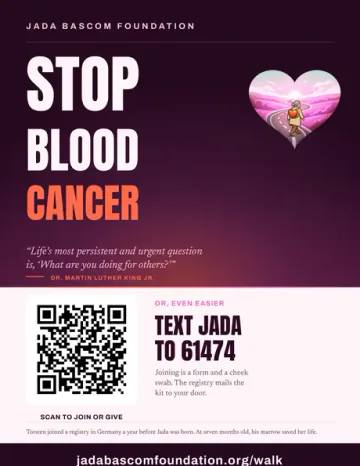
The foundation began with one match across a border. A stranger in Germany registered, and years later his cells reached a child in Washington State. You can read Torsten and Jada’s story for how that single registration changed a family.
More community-focused stories are part of the foundation’s ongoing work. If you have a story you would like to share, you are welcome to reach us through our contact page.
Frequently asked questions
Why are bone marrow donors of color needed?
HLA matching is influenced by genetic ancestry, so patients of color have lower match probabilities when the registry holds fewer donors of similar ancestry. More registered donors from underrepresented communities directly raises the match rate for patients from those communities.
What is the match-rate gap?
It is the difference in the chance of finding a fully matched unrelated donor by ancestry. White patients find a match at the highest rate, roughly 75 to 80 percent, while Black patients face the longest odds, around 30 percent or lower, with Hispanic and Asian patients in between, per published HRSA and peer-reviewed data.
Why does ethnicity affect bone marrow matching?
HLA proteins are inherited and vary across populations that were historically separated by geography. People are most likely to match donors of similar ancestry, which is why a registry needs members from every community to serve every patient. The full science is on our HLA matching page.
How can I help close the match-rate gap?
Register yourself, organize a drive in your community, and share the science of why ancestry affects matching. Each new registration from an underrepresented community raises the match probability for future patients from that community.
Are mixed-race donors valuable?
Yes, particularly so. A multiracial donor carries HLA combinations that can match across more than one population, which is why multiracial registration is especially useful given how rare those profiles are in the current registry.
Are there specific drives for my community?
National registries run community-specific recruitment programs, and organizations such as the Asian American Donor Program and the Icla da Silva Foundation focus on specific communities. You can also contact us via /contact for support organizing a drive in our region, the Pacific Northwest.
Does it matter if my heritage is recent or distant?
Both matter. Recent generations contribute the most to your HLA profile, but ancestry from further back still counts, because HLA is inherited across all of your ancestors. Registering reflects your whole profile, not a single category.
What if my heritage is mixed in ways the registry doesn’t list?
Register anyway. The registry records your actual HLA markers, not a checkbox, so your unique profile contributes to matching across multiple populations regardless of how your heritage fits predefined categories.
How do I organize a donor drive in my community?
Most drives start with a host space and a date: a church, mosque, temple, campus group, cultural association, or workplace, often during an event people already attend. JBF provides education and local drive-planning support; the registry provides and processes its own enrollment materials. Reach us through /contact and we can help you plan a drive in the Pacific Northwest.
Why are Pacific Islander and multiracial donors so underrepresented in the registry?
Both groups are recorded in small numbers relative to their populations. Pacific Islander communities are sometimes folded into a broader Asian American and Pacific Islander (AAPI) category in recruitment, which can obscure their distinct HLA profiles, and many islands have small diaspora populations in the regions where most drives are held. Multiracial people are among the fastest-growing groups in the US, and registration has not kept pace with that growth. Because their profiles are rare in the pool, each registration from these communities adds options that are difficult to replace.
Does registering help patients outside my own community?
Yes. A registry profile is matched on HLA markers, not on a self-reported category, so your profile can match any patient whose markers align with yours, including patients of different or mixed backgrounds. Registering raises the match probability most for patients of similar ancestry, and it also widens the pool for everyone searching.
What to do next
- Learn the HLA matching science: What is HLA matching?
- Read Torsten and Jada’s story: The match that started the foundation
- Helping a loved one with a diagnosis? How to help someone who needs a match
- How to find and join your registry: The step-by-step way to register
- Which registry should you join? Find the right registry for your country
The registry can only match patients to the donors it holds. Adding your profile, whatever your background, widens the odds for the next patient searching for a match. It starts by finding the official registry serving your country and following its enrollment process.

The official registry serving your country sets its enrollment method, timing, cost, sample collection, and any kit or mailing instructions.