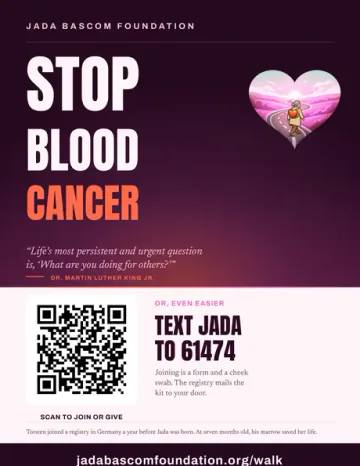
Your loved one needs a bone marrow match. Here is how to help find one.
Start with your loved one’s transplant team. They coordinate the donor search and tell relatives how to arrange HLA testing. Public registry signup is a separate way to help any patient in need.
The official registry serving you sets its current enrollment method, sample collection, timing, costs, kit or mailing instructions, and any drive support or materials.
Last updated
What you can do today
- Ask the transplant team about family testing. The team decides which relatives should be tested and arranges HLA testing for your loved one. Public registry signup is separate and does not test you for a specific relative. If you are willing to help any patient, use the official registry serving your country to review its current enrollment method, timing, cost, and sample-collection process.
- Organize a drive for your loved one. A drive aimed at people who share the patient’s ethnic background can add dozens of new registry members in days. The patient’s transplant team can help coordinate it.
- Share their story. Patient-specific campaigns have helped find matches in cases where the existing registry pool did not already hold one.
The official registry serving you sets its current enrollment method, sample collection, timing, costs, kit or mailing instructions, and any drive support or materials.
Can family members match? The truth
The first hope for most families is a relative. Sometimes that works. More often it does not, and knowing the real odds early helps you act on the unrelated registry without losing time.
- Siblings: each full sibling has about a 25% chance of being a 10/10 match, because each child inherits one of two HLA sets from each parent. Most siblings are not matches.
- Parents: usually only a half-match (haploidentical) with their child, not a full match, though haploidentical transplants are viable when no other donor is found.
- Children: the same as parents — usually a half-match with their parent.
- Cousins: very rarely a full match. The probability is close to that of a random unrelated donor.
- More distant relatives: almost never a match. HLA inheritance means the odds fall off quickly outside the immediate family.
- Identical twins: always a perfect match, but used less often than you might expect, because the transplant lacks the graft-versus-tumor effect that helps clear remaining cancer cells.
The reality: according to NMDP, 75% of patients do not have a fully matched donor in their own family and rely on the unrelated registry. That is why registry size and diversity decide whether a given patient finds a donor at all.
The matching science behind these odds is explained by the National Cancer Institute and the Mayo Clinic, and the US donor program is run through the HRSA C.W. Bill Young Cell Transplantation Program.
Organizing a drive for your loved one
Why patient-specific drives work: a drive recruits new registry members from communities with HLA backgrounds similar to the patient’s. That raises the chance of a match for this patient and adds donors who may match future patients from the same communities.

How to start one:
- Ask your loved one’s transplant team to coordinate with the official registry (NMDP in the US).
- Ask the official registry whether it supports patient-specific drives and which materials or enrollment instructions it can provide.
- Use social media and community networks to recruit people to register at the drive.
- Hold the drive at a school, place of worship, community center, or workplace.
- Set a clear date, time, and place, and ask a few reliable people to help run the table so you are not doing it alone.
- Write a short script for volunteers covering who the drive is for and directing people to the official registry for its current age, health, enrollment, and sample-collection requirements, so everyone gives the same accurate information.
- Follow up afterward with a thank-you and the registry sign-up link, and ask whether that registry offers remote or online enrollment for people who missed the event.
A practical note on expectations: a drive that signs up many people may still not produce a direct match for your family member, because matching depends on HLA type rather than effort. Every person who joins, though, becomes searchable for this patient and for others, so the work is rarely wasted even when the immediate result is not the one you hoped for.
The Jada Bascom Foundation supports drives in our community. Reach us through our contact page for help with drives in the Pacific Northwest, where we operate. We can help with logistics, materials, and amplification.
Learn more about registration drives and how they are run.
Common transplant diagnoses
These are some of the conditions most often treated with a bone marrow transplant. Our plain-English guides explain each one and cite their sources, and the specialist centers linked below go deeper into clinical detail. The patient’s own transplant team guides every decision.
Leukemia (AML, ALL, CML)
Transplant is used for several leukemia types, especially when chemotherapy alone is not enough. Acute Myeloid Leukemia (AML) is one of the most common transplant indications, and Acute Lymphoblastic Leukemia (ALL) often affects children, treated at pediatric transplant centers such as St. Jude Children’s Research Hospital.
Lymphoma (Hodgkin, Non-Hodgkin)
Transplant may be used after a relapse or for aggressive variants. Both autologous (using the patient’s own cells) and allogeneic (using a donor) approaches exist, as Memorial Sloan Kettering Cancer Center describes.
Sickle Cell Disease
A bone marrow transplant is one of the few potentially curative options for sickle cell disease, and pediatric outcomes have improved substantially over the past decade. The National Heart, Lung, and Blood Institute and St. Jude Children’s Research Hospital cover it in depth.
Aplastic Anemia
Severe aplastic anemia is one of the conditions where a transplant is most effective. The Dana-Farber stem cell transplant program describes how it is used.
Other conditions
Bone marrow transplants are also used for Severe Combined Immunodeficiency (SCID), Myelodysplastic Syndromes (MDS), and a range of inherited blood disorders. The National Cancer Institute maintains an overview of the conditions treated this way.
Supporting your loved one through transplant
The process is long. Conditioning chemotherapy, the transplant itself, and early recovery can mean weeks to months in or near a hospital, followed by a long stretch of ongoing care. Planning for that length of time helps.
Graft-versus-host disease (GVHD) is a real risk even after a well-matched transplant. Setbacks happen, and the transplant team manages GVHD with medication and supportive care.
The load on caregivers is significant. Available support resources include the American Cancer Society, NMDP’s patient-support resources at nmdp.org, and the Leukemia & Lymphoma Society. These are listed as resources that exist, not as endorsements.
Practical help is often the most useful. Transplant frequently means weeks near a treatment center, so coordinating lodging, transport, meals, and time off work is part of the support a family provides. Many transplant programs have social workers and patient navigators whose role is to help with exactly these logistics, and asking the care team early about what assistance is available can save time later.
Share the work where you can. Caregiving is hard to sustain alone over a process that can run for months. Some families keep a simple shared calendar or a sign-up list so that friends and relatives can take on specific tasks, such as a hospital visit, a grocery run, or childcare, rather than asking the primary caregiver to carry everything.
Frequently asked questions
Can a sibling be a bone marrow match?
Each full sibling has about a 25% chance of being a 10/10 HLA match, because each child inherits one of two HLA sets from each parent. Most siblings turn out not to be a match, which is why the unrelated registry matters even for patients with brothers and sisters.
Can parents be a bone marrow match for their child?
A parent is usually only a half-match (haploidentical) with their child, not a full match. Modern haploidentical transplant protocols make a parent or child donor viable when no fully matched donor is available, but the transplant team makes that decision.
Can a stranger be a bone marrow match?
Yes, and most matches come from unrelated donors. According to NMDP, 75% of patients do not have a fully matched donor in their own family, so the majority rely on the unrelated registry.
How do I get tested as a potential bone marrow match for my family member?
Contact the patient’s transplant team. They arrange HLA testing for family members directly, separately from the public registry. If you want to be available for any patient, use the official registry serving you to review its current enrollment method and sample-collection process.
How do you find a bone marrow match?
Through the unrelated registry, which is the most common route, or through family testing arranged by the transplant team. Searches run across national and international registries through the World Marrow Donor Association.
How long does it take to find a bone marrow match?
It varies. Some patients have a match identified within days; others wait weeks or months, and some never find a fully matched unrelated donor. A patient-specific drive that recruits people of similar ancestry can improve the odds.
What if there’s no match in the registry?
A haploidentical transplant from a half-matched family member, or a cord blood transplant that tolerates more mismatch, may be options. These decisions are made by the patient’s transplant team based on the patient’s specific situation.
Can a cousin be a bone marrow match?
Rarely. A cousin’s probability of being a full HLA match is roughly the same as that of a random unrelated donor, because HLA is inherited as a set and that set is shared closely only within the immediate family.
Are siblings always a bone marrow match?
No. A full sibling matches at a 10/10 level only about 25% of the time. The other roughly three-quarters of siblings are not full matches, even though they share the same parents.
How can I help find a match for someone with sickle cell?
Register yourself, especially if you share ethnic background with the patient, since HLA types track with ancestry. You can also organize a drive in your community and share the patient’s story. Bone marrow transplant is one of the few potentially curative options for sickle cell disease.
How do I ask people to join the registry for my family member?
Be direct about what you are asking and why. Explain that your family member needs a donor, and link people to the official registry serving them so it can explain its current enrollment steps and commitments. People often respond to a specific name and a clear next step, so include the registry link and, if you are running a patient-specific drive, the date and location. It helps to mention that a registrant is most likely to match someone of similar ancestry, which is why people who share the patient's background are especially needed.
Can I donate blood or platelets to help my loved one?
Blood and platelet donation is separate from the bone marrow registry, but it can matter during treatment, because patients undergoing a transplant often need transfusions. Most patients cannot receive blood directed specifically to them, so donations generally go to the shared supply that the hospital draws from. Your loved one's care team or the hospital's blood bank can tell you how donations are handled where they are being treated.
What support exists for caregivers during a transplant?
Caregiving through a transplant is demanding, and support resources exist for it. Many transplant centers have social workers, financial counselors, and patient navigators who can help with logistics, lodging near the hospital, and time away from work. National organizations including the American Cancer Society, the Leukemia & Lymphoma Society, and NMDP's patient-support services maintain caregiver resources and helplines. These are listed as resources that exist, not as endorsements; the patient's transplant team can point you to the ones tied to their program.
How do I run a virtual or online donor drive?
An online drive recruits registrants without an in-person event. Ask the official registry coordinating your drive whether it can provide a dedicated sign-up page or code tied to your family member's campaign. Share that link through social media, group chats, and community or workplace networks, and pair it with a short explanation of who the drive is for and where people can review that registry's current enrollment process. Online drives are well suited to reaching people across different cities, which can widen the pool of potential donors from the patient's background.
What to do now
Ask your loved one’s transplant team about testing for that patient. If you also want to be available as a donor for any patient, the official registry serving you explains its current enrollment steps. JBF helps you find that registry; it does not test or match donors.

The official registry serving you sets its current enrollment method, sample collection, timing, costs, kit or mailing instructions, and any drive support or materials.