Jada Bascom Foundation
Skip to action

WHY MATCHING IS SO HARD

A life-saving transplant can depend on finding one person.

Why finding a matching blood stem cell donor is so hard — from a leukemia diagnosis to the global registry.

An interactive story from the Jada Bascom Foundation. Educational information only — the Foundation refers people to independent donor registries; it does not run one, and it does not provide medical care or individual advice.

Why Matching Is Hard

Leukemia Explained

This is the cell a donor gives. Not an organ. The cell that starts blood.

  • Red blood cellsCarry oxygen. About 120 days each.
  • PlateletsStop bleeding. About 8 to 10 days.
  • White blood cellsFight infection. Hours to years, depending on the type.

The two-road branch is a teaching simplification — current research describes blood cell development as more of a continuum than a clean tree. What holds is the tempo: because blood turns over this fast, a marrow that stops working properly shows up in weeks, not years. Acute leukemia is called acute because the cells stop maturing — and that turnover is why the shortage is felt almost at once.

This is not something a person brings on themselves. Leukemia is not contagious, is only rarely inherited, and in most people no cause is ever found.

  • Too few red cells — tiredness a full night of sleep does not touch, breathlessness on the stairs, a paler face than usual.
  • Too few platelets — bruises you cannot account for, nosebleeds, bleeding gums, and sometimes petechiae: a pinprick rash that does not fade when you press a glass against it.
  • Too few working white cells — infections that keep returning, or one that will not clear.
  • And something else again: bone pain, and in children sometimes a limp, from a marrow so crowded that it presses outward on the bone.

Every one of these has ordinary explanations, and most people — most children — with one or more of them do not have leukemia. If any of it persists, the answer is a doctor, not this page. But the disguise is also why acute myeloid leukemia is so often found late: of AML diagnoses in England in 2019, about 5% came through an urgent suspected-cancer referral, while around 6 in 10 arrived through an emergency admission.

Then the marrow is read twice over — flow cytometry asks what the cell is, and genetic testing asks what went wrong. Those genetic results sort the leukemia into favorable, intermediate or adverse risk, and that sorting is a major input into whether anyone starts looking for a donor. An abnormal blood count on its own is not a diagnosis.

So the word “leukemia” on its own tells you very little about what someone is facing. Which leukemia is not a detail. These are US population figures covering people diagnosed years ago; they lag behind current treatment, they differ between countries and health systems, and they cannot predict any one person’s outcome.

  • Mouth and gut ulceration. In a 1999 interview study, 38 adults who had been through a transplant were asked to name the single most debilitating side effect: 42% chose mouth sores, 13% nausea and vomiting.
  • Hair, usually starting two to four weeks in, with the scalp aching while it goes. It grows back — often finer, sometimes curlier, sometimes a different color.
  • Fatigue that sleep does not fix, and that people describe as different in kind from ordinary tiredness — less like being tired than like having had the energy taken out of them.
  • Food that tastes of metal, or of nothing at all, so people eat with wooden cutlery and stop eating out of pointlessness rather than nausea.
  • A temperature over 38°C (100.4°F) that is no longer a nuisance but an emergency. Many services aim to start antibiotics within an hour of arrival.

Nausea is far better controlled than it once was — medicines are given before treatment rather than after symptoms start — though control is not complete. Regimens differ by subtype, age and country, and are chosen by a treating team.

Some people with leukemia may be evaluated for an allogeneic blood stem cell transplant. Treatment decisions are individual and should be discussed with the transplant team.

That is the point at which a team may begin looking for a donor.

A transplant is offered when the risk of the leukemia returning outweighs the risk of the transplant itself. That judgment belongs to a patient and their team.

This is the genuinely dangerous part. For a stretch of days the patient has almost no working marrow at all, deliberately.

Many recipients count a second birthday from day zero for the rest of their lives.

  • A single room with the door kept shut, one or two named visitors, and no fresh flowers on the ward — rules differ between hospitals, but the shape is the same: the room protects you by keeping everyone out of it.
  • Someone else’s blood, constantly. Red cells keep for roughly 35 to 42 days and platelets for only about 5 to 7, depending on country and processing, so the need never stops.
  • A care partner on the clock around the clock. Transplant centers generally require one to be named before transplant and available twenty-four hours a day for roughly the first hundred days, and studies of transplant caregivers find their distress runs as high as the patients’ own.
  • The fertility conversation, held within days of diagnosis and often with someone in their teens or twenties. Collecting eggs needs roughly two weeks of stimulation first, and acute leukemia often cannot wait that long; banking sperm takes a day, and ovarian tissue can sometimes be frozen instead.

Engraftment is the first morning the count rises instead of falling. Families learn to read a blood panel the way other people read a weather forecast.

If this is happening to you or someone you love, the people to ask are your own transplant team — they know your case, and this page cannot. Blood cancer charities in most countries run free helplines staffed by nurses.

So what a donor gives is not spare parts. It is a living immune system, and it has to recognize the body it lands in.

None of that is a forecast. Risk differs enormously with age, disease, regimen and donor, it has been falling, and a great many people transplanted years ago are living ordinary lives now. It is here because a version of this story that stopped at the good morning would be a recruitment page rather than an explanation — and because the people living through the year afterward deserve to see it written down.

HLA class I protein. Simplified illustration.

Move across the molecule — open a numbered marker.

That count is of known, sequenced versions rather than everything that exists, and it will be out of date within months.

A closer match is a better transplant. In an NMDP analysis of 3,857 unrelated-donor marrow transplants performed in the United States between 1988 and 2003, one-year survival was 43% where the donor differed at one of the eight markers, against 52% for an 8/8 match. Outcomes have improved a great deal since that era; the finding that has lasted is that every mismatch costs something.

Usually, not always — the block can be broken by recombination. That is why a transplant team types every family member directly instead of inferring anyone from anyone else.

25.0%
Chance of at least one full sibling match

Each full sibling independently has a 25% chance. Testing more siblings raises the odds that one of them matches — it never changes any single sibling’s 1-in-4.

And there is the particular silence of the sibling who is not a match.

That number deserves three cautions. It is a live counter, so it was already out of date when you read it. It adds two different things together: people who volunteered, and frozen units of donated cord blood — a unit is not a person. And a source is not the same as a national registry; some countries list several, some listings are cord blood banks, and a country absent from that list has not been shown to have no route at all. The Association itself is not somewhere you can join. It sets standards and runs the machinery that lets registries search each other.

Full unrelated-donor availability is not equal for every community.

In NMDP data, availability of an 8/8 matched unrelated donor ranged from approximately 29% for Black patients to 79% for White non-Hispanic patients.

  • United States NMDP research context, June 2024.
  • Population-level donor availability, not an individual prediction.

This is a gap in who is represented on registries, combined with how HLA varies between populations. It is not a gap in generosity, and no group’s biology is harder to match in itself.

A possible match is shown in gold.

  • HLA is inherited, so matching follows ancestry rather than appearance or blood type.
  • The combinations that are common differ from population to population.
  • Who is represented on a registry changes who can be found on it.
  • Choosing a donor involves clinical factors beyond HLA alone.

Which is exactly why registries pursue both things at once — recruiting more people, and advancing the science that makes mismatched transplants work. Joining is necessary. It is simply not sufficient on its own.

  • Contact details go stale. Someone who joined at a university drive at 19 can be unreachable at 26 — matched, willing, and invisible.
  • Some people are deferred for medical reasons entirely outside their control.
  • Some say no, which is their right, at any point.
  • And a search does not stop at one name. More than one possible donor is often checked for the same patient, precisely because any one of them may turn out to be unreachable, unwell, or unwilling.

Whether those hours are protected at work depends entirely on where you live. We found two protections written into law: in the United States, federal executive-branch employees are entitled to up to seven days of paid leave a year for marrow donation, and Italian law preserves a registered donor’s pay for tests, admission, donation and recovery. We could not verify a general protection anywhere else, which is not the same as proving none exists — but it does mean you should assume there is none until you have checked.

  • Body size is usually judged at the point of a match, and not by one number — NMDP publishes a maximum weight for each height, while Anthony Nolan applies a BMI ceiling of 40 for a bloodstream donation and 35 for a marrow one.
  • Pregnancy is nearly always a pause rather than a bar. Several registries let you join while pregnant and hold you out of searches until around six months after the birth.
  • Autoimmune conditions turn on which condition. More than one registry accepts a stable, well-controlled thyroid condition while excluding active systemic disease.
  • A cancer history usually excludes — with named exceptions that recur across registries, including basal cell skin cancer and carcinoma in situ of the cervix.
  • Medication is rarely the deciding factor by itself. NMDP puts it plainly: it is usually not the drug, but the condition the drug is for.

Examples read from those registries’ own pages on 27 July 2026, and they change. This page cannot tell you whether you are eligible — only the registry serving your country can, and deciding is its job rather than yours. People rule themselves out far more often than the rules do.

8 of 8markers match

A schematic comparison — not any specific person

The transplant team considers HLA along with other medical and donor factors.

A donor is asked which methods they are willing to do, and a registry does not proceed with one they have not agreed to.

Greater tolerance is not the absence of matching. Compatibility, cell dose, the quality of the unit, the disease and the centre’s own experience all still bear on whether a particular unit can be used at all.

  • Too few cells can mean slower recovery of the blood counts and a greater chance the graft never takes hold.
  • Some teams have used two units when one was not enough — though a US trial in 224 patients aged 1 to 21 found no one-year survival advantage for two, and its single-unit recipients recovered platelets faster with less severe GvHD.
  • Public collection runs only at participating hospitals — four in Canada, three in England. Most maternity units in the world cannot collect at all, so for most families the answer is decided by geography before anything else.

Donating to a public bank costs a family nothing, and the unit then belongs to whoever needs it — it cannot be held back for your own family. Private banking stores it for you and charges for that. In March 2019 the American College of Obstetricians and Gynecologists said routine private banking is not supported by the available evidence and recommended public donation, treating storage for a relative with an already diagnosed need as a separate case. That is US professional guidance, not a worldwide rule. Worth knowing either way: a child’s own stored unit is not automatically the right graft for that child — the FDA notes that for genetically heritable diseases it may not be recommended, and that a bank being registered with the FDA is not the same as being endorsed by it.

Better matching is one of the main ways a transplant team reduces those risks.

This does not make matching unimportant. A better match is still a better transplant, and these are trial results in one group of patients. What it changes is the meaning of “no match found” — that sentence is no longer the end of the search.

What joining actually involves

  • Joining is a cheek swab. A kit arrives in the post, you rub what Anthony Nolan calls “giant cotton buds” inside your cheeks, and you post it back. No needle. No cost.
  • Most people who join are never called. Anthony Nolan puts the chance of being asked within five years at roughly 1 in 800, and about 1 in 200 for men aged 16 to 30. NMDP says it cannot predict the chance for any one person, because there are so many different tissue types.
  • If you are called, about 90% of donations are not surgery. You have injections for four or five days, then blood is drawn from one arm, passed through a machine that separates out the blood-forming cells, and returned through the other. That takes four to eight hours, and sometimes a second session the next day.
  • Those injections cause a real, well-documented bone ache. In a prospective NMDP study of 2,408 unrelated donors, 97% reported some bone pain, 9% called it severe and 1% called it intolerable. A week after collection 6% still had pain; for almost everyone it had gone.
  • The rest are marrow donations: hollow needles into the back of the pelvic bone — the hip, not the spine — under general anesthetic in nearly all cases, taking one to two hours. Afterward NMDP reports back or hip pain in 84% of donors and fatigue in 61%; most are back to normal activities within two to seven days, and the body replaces what was taken within weeks.
  • Serious side effects are uncommon but not zero. NMDP reports fewer than 1% for either procedure. Every donor is medically assessed first, and that decision belongs to the registry’s medical team.
  • It is not one appointment. NMDP puts the whole process at an average of 20 to 30 hours spread over four to six weeks, and that figure does not include travel.
  • Money should not be the obstacle, but “free” is a programme policy rather than a law. NMDP says it covers travel, hotels, meals, childcare, pet boarding and lost wages. Anthony Nolan covers loss of earnings where an employer does not, including for self-employed donors. Canadian Blood Services says some lost wages may be covered — “may”, not “will”. Check what the registry serving your country actually commits to. Nobody is ever paid for the cells themselves.
  • You will most likely never learn who they were, and the rules differ by country. NMDP allows anonymous messages in the first year and direct contact after that if both people consent and the centres allow it; Anthony Nolan describes possible direct contact after two years. Italian law requires anonymity to continue. Some countries do not permit identifying contact at all, and public cord blood donation stays anonymous permanently.
  • You can say no at any time — but once a patient has begun the treatment that destroys their own marrow, withdrawing can be fatal for them. Registries make sure you understand that point long before it arrives.

Every registry sets its own age limits: NMDP takes new members aged 18 to 35, Anthony Nolan 16 to 30, DKMS UK 16 to 55. Registries prioritize younger donors because large analyses have linked them to better patient survival. Find the registry that serves your country.

What happens between a match and a donation

  1. A registry gets in touch. At that moment you are a possible match, not a chosen donor. More than one person is often checked for the same patient, and most of them do not go forward.
  2. Confirmatory typing. A fresh sample and a new health and availability check confirm the tissue type in finer detail. DKMS UK, for one, then reserves you for that patient for around three months.
  3. Counselling and consent, covering both collection methods, the short- and long-term risks, the travel, the time — and your right to stop.
  4. A medical assessment. History, examination, blood and urine tests, an ECG, and a check of your veins, set by the programme and the method. Anthony Nolan schedules its medical two to four weeks ahead of donation and puts the appointment at two to three hours. Something found here can pause or end the plan, and that is precisely what it is for.
  5. Scheduling, which slips. Delays and cancellations are common enough that Anthony Nolan warns donors about them outright, and some tests expire and have to be repeated.
  6. Then the collection itself — and a follow-up that continues after you have gone home.

Those timings are the ones each programme publishes for itself, read in July 2026. There is no worldwide schedule, and the registry serving your country sets its own. One structural point is worth knowing: international standards require that the person who takes your consent and assesses whether donating is safe for you is not the person responsible for treating the patient. The people looking after you are deliberately not the people under pressure to obtain the cells. Where a donor is a child, or cannot consent for themselves, a separately appointed advocate is required.

If you cannot join

  • Give blood or platelets — if your blood service accepts you. That is a separate decision, made by a different organisation under different rules, so being turned down by a marrow registry tells you nothing either way. It matters: people in intensive treatment and the weeks after a transplant live on transfused red cells and platelets, and platelets keep only days, so the need never stops. What it is not is an HLA-matched graft, and it is not a substitute for someone joining the registry.
  • Donate cord blood, if you are expecting and your hospital can collect it. Public collection runs only at participating hospitals — four in Canada, three in England — so the first question is whether yours is one of them. Where it is possible it costs the family nothing, the collection happens after mother and baby are safely delivered, and it adds a graft that can be used across a wider HLA mismatch than an adult donor.
  • Recruit. Share this, run a drive, or raise it where you work. The people most needed on registries are the least likely to have signed up.
  • Volunteer or give. Outreach is how registries reach the communities where the gap is widest.

Why this Foundation exists

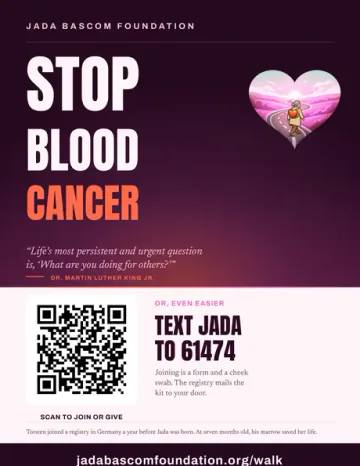
Jada Bascom was a young woman who needed a matching donor. The Jada Bascom Foundation was built by her family around the search that followed, and it does one thing: it helps people find the donor registry that serves their country, and tells them the truth about what joining involves. It does not run a registry, collect swabs, or provide medical care — those belong to the registries and to medical teams.