Diagnosis guide · Leukemias
Leukemia
If you or someone you love has just heard this diagnosis, start here. It covers several subtypes, and this guide shows how they differ, so you can find the one on your report.
Leukemia is a broad name for cancers of the blood cells. Doctors sort it in two ways. Acute leukemia grows fast and usually gets worse quickly if it is not treated; chronic leukemia grows more slowly. Myeloid leukemia starts in cells that would become red cells, platelets or some kinds of white cells. Lymphoid (lymphocytic) leukemia starts in lymphocytes, a type of white blood cell. Tests then find the exact subtype and its gene changes, and these results help guide treatment. A donor stem cell transplant is an established option for selected people with some types, such as higher-risk AML and ALL. Most people with CLL or CML are treated without one.
In short
- Leukemia is a broad name for cancers of the blood cells. Doctors sort it as acute or chronic, and as myeloid or lymphoid.
- Tests find the exact subtype and its gene changes, and the results help guide treatment. Treatment may be chemo, targeted medicines or other therapies.
- For some types, such as higher-risk AML and ALL, selected people have a donor stem cell transplant. Most people with CLL or CML are treated without one.
16 subtypes
Find the subtype on your report
The exact diagnosis shapes the treatment options. Your care team can explain the name on your report.
Acute myeloid leukemia 3 subtypes
Fast-growing leukemias that start in immature myeloid cells.
Acute myeloid leukemia (AML)
Acute myeloid leukemia (AML) is a fast-growing cancer of blood-forming cells. Treatment is tailored to the leukemia’s genetic features, response to therapy and the person’s health; some people benefit from a donor stem cell transplant.
Donor transplant optionAcute promyelocytic leukemia (APL)
Acute promyelocytic leukemia (APL) is a distinct form of AML, usually driven by a PML::RARA gene fusion. It can cause dangerous bleeding, but prompt treatment with differentiation medicines allows many people to recover without a stem cell transplant.
Limited transplant roleTherapy-related AML and MDS (t-AML, t-MDS)
Therapy-related AML and MDS are blood cancers that can develop months or years after chemotherapy or radiation for an earlier illness, usually another cancer. The WHO calls this group myeloid neoplasms post cytotoxic therapy. It is treated much like other AML and MDS, and it is often harder to treat.
Donor transplant option
Acute lymphoblastic leukemia 3 subtypes
Fast-growing leukemias that start in immature lymphocytes.
B-cell acute lymphoblastic leukemia (B-ALL)
B-cell acute lymphoblastic leukemia (B-ALL) is a fast-growing cancer of immature B lymphocytes. Treatment often controls it without transplant, while donor transplantation and selected immunotherapies are important for some higher-risk or relapsed cases.
Donor transplant optionPhiladelphia-positive acute lymphoblastic leukemia (Ph+ ALL)
Philadelphia chromosome-positive ALL is usually a B-lineage acute leukemia containing the BCR::ABL1 fusion. The fusion makes an overactive growth-signaling enzyme, so treatment includes medicines directed at that target.
Donor transplant optionT-cell acute lymphoblastic leukemia (T-ALL)
T-cell acute lymphoblastic leukemia (T-ALL) is a fast-growing cancer of immature T cells. Treatment uses an ALL regimen; donor transplantation is considered when the response or disease features indicate a substantial risk of relapse.
Donor transplant option
Chronic and other mature-cell leukemias 5 subtypes
Leukemias of more mature cells. Most grow more slowly than acute leukemia, but a few rare types, such as aggressive NK-cell leukemia, grow fast.
Chronic lymphocytic leukemia (CLL/SLL)
Chronic lymphocytic leukemia and small lymphocytic lymphoma (CLL/SLL) are two presentations of the same mature B-cell cancer. Many people initially need monitoring; targeted medicines are the usual treatment, and donor transplantation is reserved for selected difficult-to-treat disease.
Limited transplant roleChronic myeloid leukemia (CML)
Chronic myeloid leukemia (CML) is a blood cancer driven by the BCR::ABL1 fusion. Most people start with a targeted medicine, while a donor stem cell transplant remains an option for resistant disease or progression.
Limited transplant roleHairy cell leukemia (HCL)
Hairy cell leukemia (HCL) is a rare, slow-growing cancer of B cells that builds up in the bone marrow and spleen and lowers normal blood counts. Nearly all classic cases carry a BRAF V600E change in the leukemia cells.
Limited transplant roleT-cell prolymphocytic leukemia (T-PLL)
T-cell prolymphocytic leukemia (T-PLL) is a rare, often aggressive cancer of mature T cells. It can produce a very high lymphocyte count, enlarged organs, skin involvement and systemic symptoms.
Donor transplant optionAggressive NK-cell leukemia (ANKL)
Aggressive NK-cell leukemia (ANKL) is a very rare, fast-growing cancer of mature natural killer (NK) cells in the blood, bone marrow, liver and spleen. It is usually linked to Epstein-Barr virus and often causes fever, liver problems and severe inflammation.
Donor transplant option
Mixed and overlap leukemias 5 subtypes
Leukemias with features of two types: myeloid and lymphoid, or myelodysplastic and myeloproliferative.
Chronic myelomonocytic leukemia (CMML)
Chronic myelomonocytic leukemia (CMML) is a blood cancer with both abnormal blood-cell development and excess monocytes. Treatment depends on its pace and risk; a donor stem cell transplant is the established option with curative potential for eligible people.
Donor transplant optionJuvenile myelomonocytic leukemia (JMML)
Juvenile myelomonocytic leukemia (JMML) is a rare blood cancer of early childhood driven by abnormal RAS-pathway signaling. Most children need a donor stem cell transplant, while a small genetically defined group may follow a different course.
Donor transplant optionAtypical chronic myeloid leukemia (aCML)
Atypical chronic myeloid leukemia (aCML) is a rare blood cancer with features of both myelodysplastic syndromes and myeloproliferative neoplasms. The marrow makes too many abnormal neutrophil-line cells. It lacks the BCR::ABL1 gene that defines CML, and the WHO now calls it MDS/MPN with neutrophilia.
Donor transplant optionB/myeloid mixed-phenotype acute leukemia (MPAL)
B/myeloid mixed-phenotype acute leukemia (MPAL) is an acute leukemia with defining features of both B-lymphoid and myeloid lineages. Expert review of cell markers and genetics is needed because this is different from ordinary B-ALL or AML with an occasional extra marker.
Donor transplant optionMyeloid/lymphoid neoplasm with FGFR1 rearrangement
Myeloid/lymphoid neoplasm with FGFR1 rearrangement is a rare, aggressive blood cancer caused by a broken and rejoined FGFR1 gene on chromosome 8 (8p11). It can appear as a myeloproliferative neoplasm, an acute leukemia or a lymphoma, often with extra eosinophils. It used to be called 8p11 myeloproliferative syndrome.
Donor transplant option
Also in this group
More leukemias explained in the library.
For some of these subtypes, a patient needs a donor who is not a relative. The registry that serves your country explains who can join.
See if you can joinNearby
Related diagnosis guides
- Types of blood cancerThe wider group this guide belongs to
- Acute lymphoblastic leukemia (ALL)A closer look at some of these subtypes
- LymphomaShares some subtypes with this guide
- Non-Hodgkin lymphoma (NHL)Shares some subtypes with this guide
- Myeloproliferative neoplasms (MPNs)Shares some subtypes with this guide
- Myelodysplastic syndromes (MDS)A related diagnosis
What to know
Key facts
- Main types
- Four: ALL, AML, CLL and CMLAs grouped by MedlinePlus, U.S. National Library of Medicine (last updated November 2023). NCI also covers rarer types, such as hairy cell leukemia. Source: Main types
- New cases expected in the U.S.
- About 67,790 in 2026All leukemia types, United States, 2026 projection by the American Cancer Society, as reported by SEER. Source: New cases expected in the U.S.
- Median age at diagnosis
- 68 yearsAll leukemia types, U.S. SEER 21 areas, people diagnosed 2019–2023. Source: Median age at diagnosis
- In children
- The most common childhood cancer: 25.7% of new casesChildren and teens ages 0–19, U.S. SEER 21 areas, new cases 2019–2023. Source: In children
- Share of donor transplants
- AML 42% · ALL 15%Donor (allogeneic) transplants reported to EBMT, the European transplant society, in 2024, from 688 centers in 53 countries. Source: Share of donor transplants
How leukemia is diagnosed
Leukemia is often first suspected from a complete blood count (CBC). This common blood test counts red cells, white cells and platelets. A blood smear, a look at the blood under a microscope, can show blasts, which are young, abnormal blood cells. Chronic leukemia may cause no symptoms at first. NCI notes that CLL may be found during a routine blood test.
To diagnose acute leukemia and CML, doctors test the blood and the bone marrow. A needle takes a little liquid marrow and a tiny piece of bone, usually from the hip bone (bone marrow aspiration and biopsy). For CLL, the tests NCI lists are blood tests, including flow cytometry.
Lab tests on the leukemia cells then find the exact type. Immunophenotyping uses antibodies to read markers on the cells. In ALL, for example, it shows whether the leukemia began in B cells or T cells. Chromosome tests (cytogenetic analysis and FISH) and molecular tests look for gene changes. One example is the Philadelphia chromosome. It creates the BCR::ABL1 gene, which most people with CML have.
These results help plan treatment and help doctors judge the likely outcome (prognosis). A BCR::ABL1 change, for example, can be treated with targeted pills called TKIs. In acute leukemia, a spinal tap (lumbar puncture) may check whether leukemia cells have reached the fluid around the brain and spinal cord.
When transplant specialists are usually consulted
U.S. guidelines from NMDP and ASTCT call for an early transplant consultation for many people with acute leukemia. They recommend detailed tissue typing (high-resolution HLA typing) at diagnosis for everyone with AML and for adults with ALL.
For CML, the same guidelines point to a consultation when TKI medicines do not work well enough or cause too many side effects, or when the disease advances. For CLL, they point to one when the leukemia stops responding to both main groups of targeted medicines (BTK and BCL2 inhibitors), or the person cannot tolerate them. The same applies when it turns into an aggressive lymphoma (Richter transformation).
Read the guidanceLooking ahead
Outlook for leukemia
The outlook for leukemia depends a great deal on the type. NCI also lists age, gene changes in the leukemia cells and how well the leukemia responds to treatment. For AML, NCI adds past treatment for another cancer and whether the leukemia has come back.
The four main types differ a lot. In U.S. SEER data for people diagnosed from 2016 to 2022, five-year relative survival ranged from 33.4% for AML to 90.2% for CLL. It was 73.2% for ALL and 71.1% for CML. As a group, children and teens have higher survival than people of all ages combined. The chronic types usually grow slowly. Drug treatment alone usually does not cure CLL. For CML, NCI says that with daily targeted pills (TKIs), survival is expected to come close to normal life expectancy for most people.
Relative survival compares people with leukemia to people in the general population. It leaves out deaths from other causes. These numbers describe people diagnosed years ago, and treatment keeps changing. They cannot tell anyone what will happen to them.
About these numbers. Each one says which group of people it comes from, and the place and years where the source gives them. It describes what happened across that group, not what will happen to any one person. And a figure measured among people who had a transplant is not the same as the number of people who need one.
- 68.6%5-year relative survival, all leukemia types
All ages and all leukemia types combined, people diagnosed 2016–2022, U.S. SEER 21 areas (excluding Illinois).
Read the source: 5-year relative survival, all leukemia types - 86.7%5-year relative survival, childhood leukemia
Children and teens ages 0–19, all leukemia types combined, diagnosed 2016–2022, U.S. SEER 21 areas (excluding Illinois).
Read the source: 5-year relative survival, childhood leukemia
Each subtype page gives the figures and details for that type.
Common questions
What are the main types of leukemia?
There are four main types. MedlinePlus sorts them by the kind of blood cell affected and by how fast they grow. They are acute lymphoblastic leukemia (ALL), acute myeloid leukemia (AML), chronic lymphocytic leukemia (CLL) and chronic myeloid leukemia (CML). NCI also covers rarer types, such as hairy cell leukemia. The American Cancer Society expects these new U.S. cases in 2026, as reported by SEER: about 22,760 of CLL, 22,720 of AML, 9,650 of CML and 6,250 of ALL.
What is the survival rate for leukemia?
It differs widely by type and by age. As a group, children and teens do better than adults, and CLL has much higher survival than AML. The outlook section on this page gives five-year figures from U.S. cancer registry data (SEER). Group numbers cannot predict what will happen to one person.
Is leukemia curable?
It depends on the type. Most children with ALL now do well. NCI reports that between 1975 and 2020, five-year survival for US children younger than 15 with ALL rose from 60% to about 90%. The chronic types are usually controlled rather than cured. NCI says treatment for CLL that is getting worse will not cure most people. For CML, NCI calls a donor transplant the only consistently successful cure. But daily TKI pills work so well that a transplant is no longer a first treatment for adults. It is mainly considered when the pills do not work well enough, cause too many side effects, or the disease advances.
What are the first signs of leukemia?
Common signs include feeling very tired, fever or night sweats, and bruising or bleeding easily. Some people lose weight or appetite, or notice tiny red dots under the skin (petechiae). Chronic leukemia may cause no symptoms at first, and NCI notes CLL may be found on a routine blood test. These signs have many other causes. Blood tests, and often bone marrow tests, are used to diagnose leukemia.
What causes leukemia?
Leukemia starts when bone marrow cells develop changes in their genetic material (DNA). MedlinePlus says the cause of these changes is unknown. Some things raise the risk. For AML, NCI lists older age, smoking, past chemotherapy or radiation, and exposure to benzene. For childhood ALL, it lists some inherited conditions, such as Down syndrome, Fanconi anemia and Li-Fraumeni syndrome. Not every child with a risk factor gets ALL, and some children with none do.
Does everyone with leukemia need a bone marrow transplant?
No. Many people are treated with chemotherapy, targeted medicines or other drugs alone. A donor stem cell transplant is used for selected people, most often with acute leukemia. In Europe, AML and ALL together account for more than half of all donor transplants. For CML and CLL, U.S. guidelines point to a transplant consultation mainly when the disease resists the main medicines or turns more aggressive.
For your next appointment
Leukemia
From the Jada Bascom Foundation disease library, jadabascomfoundation.org. Printed .
Questions to bring to your care team
- Which type and subtype of leukemia is it, and what gene changes did the tests find?
- What do those results change about my treatment, and is a targeted medicine an option?
- Could a stem cell transplant become part of my plan, and should HLA typing start now?
- How will we check whether treatment is working, including tests for leftover leukemia (measurable residual disease)?
- What is the goal of each treatment you are suggesting?
- What happens if a fully matched donor is not found?
- Where can our family find support during treatment?
A one-page list to take to the next appointment, with room for notes.
Supporting someone with a diagnosisSupport for patients and families
These independent organizations offer information and support. JBF is not affiliated with them.
- Leukemia Research Foundation US nonprofit that funds leukemia research and offers peer support, education programs and financial assistance to patients and their families.United States
- Leukaemia Care UK charity with a free helpline, support groups and practical help for anyone affected by leukemia, including families and caregivers.United Kingdom
- Leukaemia Foundation Australian charity for people with blood cancer, with support coordinators by phone, support groups and accommodation help for people traveling for treatment.Australia
Ways to help
Someone may be waiting for a match.
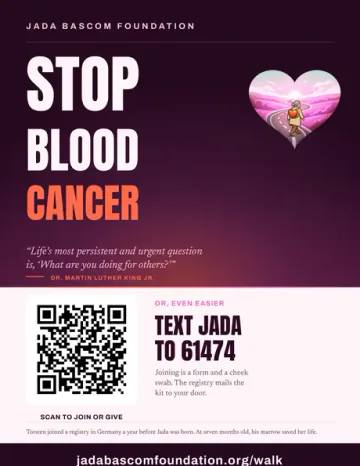
Some people with leukemia are treated with a transplant from a donor. When no relative matches, that donor is often a stranger who joined a registry.
Join the registry
JBF points you to the official registry that serves your country. It explains who can join and what donation involves.
Help someone you love find a donor
If someone you love needs a donor, our family guide explains practical ways to help. A registration drive can add many potential donors at once, for them and for others.
Support this work
Gifts to the Jada Bascom Foundation support donor-awareness education like this page, community outreach, drive planning and referrals to official registries.
Keep learning
Understanding transplant
Short explainers on what a transplant is and what it means for a family.
Sources and further reading
- Leukemia
MedlinePlus, US National Library of Medicine, 2023-11-09 - Leukemia
National Cancer Institute, Accessed 2026-09-24 - Indications for haematopoietic cell transplantation and CAR-T for haematological diseases, solid tumours and immune disorders: 2025 EBMT practice recommendations
EBMT / Bone Marrow Transplantation, 2025-09-09 - Cancer Stat Facts: Leukemia
National Cancer Institute, SEER Program, Accessed 2026-09-26 - Cancer Stat Facts: Childhood Leukemia (Ages 0–19)
National Cancer Institute, SEER Program, Accessed 2026-09-26 - Cancer Stat Facts: Leukemia — Acute Myeloid Leukemia (AML)
National Cancer Institute, SEER Program, Accessed 2026-09-26 - Cancer Stat Facts: Leukemia — Acute Lymphocytic Leukemia (ALL)
National Cancer Institute, SEER Program, Accessed 2026-09-26 - Cancer Stat Facts: Leukemia — Chronic Myeloid Leukemia (CML)
National Cancer Institute, SEER Program, Accessed 2026-09-26 - Cancer Stat Facts: Leukemia — Chronic Lymphocytic Leukemia (CLL)
National Cancer Institute, SEER Program, Accessed 2026-09-26 - Hairy Cell Leukemia Treatment (PDQ), Patient Version
National Cancer Institute, 2025-04-23 - Adult Acute Myeloid Leukemia Treatment (PDQ), Patient Version
National Cancer Institute, 2025-05-16 - Chronic Lymphocytic Leukemia Treatment (PDQ), Patient Version
National Cancer Institute, 2024-10-15 - Chronic Lymphocytic Leukemia Treatment (PDQ), Health Professional Version
National Cancer Institute, 2025-04-25 - Chronic Myeloid Leukemia Treatment (PDQ), Patient Version
National Cancer Institute, 2025-04-09 - Chronic Myeloid Leukemia Treatment (PDQ), Health Professional Version
National Cancer Institute, 2025-03-13 - Childhood Acute Lymphoblastic Leukemia Treatment (PDQ), Patient Version
National Cancer Institute, 2025-04-15 - Recommended timing for transplant consultation: Acute myeloid leukemia (AML)
NMDP and ASTCT, Accessed 2026-09-26 - Recommended timing for transplant consultation: Acute myeloid leukemia (AML), pediatric
NMDP and ASTCT, Accessed 2026-09-26 - Recommended timing for transplant consultation: Acute lymphoblastic leukemia (ALL)
NMDP and ASTCT, Accessed 2026-09-26 - Recommended timing for transplant consultation: Acute lymphoblastic leukemia (ALL), pediatric
NMDP and ASTCT, Accessed 2026-09-26 - Recommended timing for transplant consultation: Chronic myeloid leukemia (CML)
NMDP and ASTCT, Accessed 2026-09-26 - Recommended timing for transplant consultation: Chronic lymphocytic leukemia (CLL)
NMDP and ASTCT, Accessed 2026-09-26 - The 2024 EBMT activity report: crossing one million HCTs and 20,000 CAR-T. A landmark in cellular therapy
EBMT / Bone Marrow Transplantation, 2026-05-27 - Childhood Acute Lymphoblastic Leukemia Treatment (PDQ), Health Professional Version
National Cancer Institute, Accessed 2026-09-24 - 2024 Recommended Timing for Transplant Consultation
NMDP and American Society for Transplantation and Cellular Therapy (ASTCT), February 2024; accessed 2026-09-26