1
15-20 min
Who Are the Helpers?
Discover the community helpers who keep us healthy and learn about a special "hidden helper" inside our bodies.
Start Lesson
A gentle introduction to community helpers, how our bodies stay healthy, and why helping others matters. Designed for kindergarten through 2nd grade students.
The Helpers Inside Us is a four-lesson unit that introduces young learners to the concept of community helpers and extends that understanding to include our own bodies as "helpers."
This curriculum focuses on civic responsibility and the joy of helping others, rather than medical mechanics. Students will learn that:
Discover the community helpers who keep us healthy and learn about a special "hidden helper" inside our bodies.
Start LessonExplore how blood travels through your body like delivery trucks on a highway, and learn about the amazing factory inside your bones.
Start LessonUnderstand how some people need help from others to stay healthy, and how doctors can help share the gift of good health.
Start LessonLearn how kids can help spread the word about helping others, even if they cannot donate themselves.
Start LessonThis unit connects to your existing curriculum on community helpers and health. Blood is described as a "factory inside our bones" that makes blood, keeping the explanation simple and non-scary.
Dear Families,
Our class is learning about community helpers and how people help each other stay healthy. This gentle curriculum aligns with the Washington State guidance on blood and bone marrow donation awareness instruction (RCW 28A.210.430).
Students will learn that blood helps our bodies work, some people need help from doctors to stay healthy, and that even kids can be "helpers" by being kind and spreading awareness.
Important: This curriculum does not encourage children to donate anything. It teaches awareness and empathy. Donation decisions are made by adults when they are eligible.
If you have questions or would like to discuss the curriculum, please contact your child's teacher.
A curated selection of terms used across the unit. Each lesson introduces a few additional words in context — see the individual lesson pages for the full term list.
These independent organizations publish age-appropriate educational materials about blood and bone marrow. The Jada Bascom Foundation cites their work as primary sources for our curriculum; these references do not represent a formal partnership.
Educational Disclaimer: This content is for educational purposes only and does not constitute medical advice. Blood and bone marrow donation eligibility is determined by medical professionals for adults only.
The Jada Bascom Foundation does not encourage minors to register as donors. This curriculum supports awareness and informed decision-making for future adults.
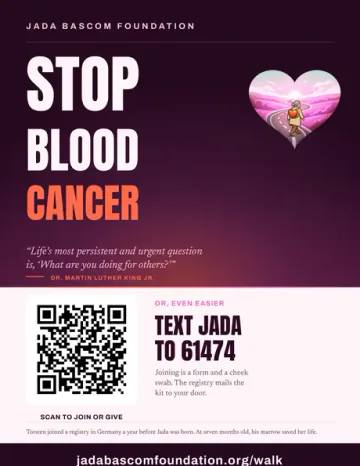
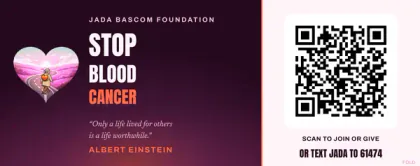
Take it off the screen
A coffee counter, a church foyer, a break room, a race table. Every sheet carries the code that opens Jeana’s walk, and a number to text for anyone who would rather not scan — no app, no wifi, nothing to hand back.Every sheet carries the code that opens Jeana’s walk — nothing to install, nothing to hand back. The number to text printed beside it is for joining NMDP, which registers people who live in the U.S., its territories and the freely associated states. If you live anywhere else, find your country’s registry.
Flyer
One page, for a wall or a noticeboard. The same sheet in three voices.
Table tent
One page that folds and stands on a table or a counter.
Everything else for running a drive
Host a registration drive at your school, work or place of worship, raise funds, or lend a skill. Tell us what you have in mind and we will help you plan it.