Weight and donor eligibility
Can you donate bone marrow if you are overweight?
NMDP assesses BMI and says underweight or overweight BMI may prevent donation when it presents a safety risk to the donor or patient. Other registries set their own current rules.
The official registry serving your country sets its enrollment method, timing, cost, sample collection, and eligibility rules.
Last updated
The short answer
NMDP assesses BMI to determine donation eligibility and says underweight or overweight BMI may prevent donation when it presents a safety risk to the donor or patient. The official registry serving your country must apply its own current BMI guidance to you.
NMDP says a person called to donate completes a health screening and physical exam before moving forward. It assesses BMI as part of determining donation eligibility.
Do not try to determine eligibility from this page alone. Ask the official registry serving your country how its current BMI guidance applies to your health history.

You can likely donate if
The official registry serving your country must apply its own current BMI guidance to you.
Needs a closer look if
NMDP says both underweight and overweight BMI require assessment and may prevent donation if there is a safety risk to the donor or patient.
The official registry serving your country sets its enrollment method, timing, cost, sample collection, and eligibility rules.
In detail
How registries review weight and BMI

NMDP assesses BMI to determine donation eligibility. NMDP says underweight or overweight BMI may prevent donation when it presents a safety risk to the donor or patient.
Weight and BMI thresholds differ by registry and country, so no single number on this page would be accurate for everyone. The official registry serving your country applies its own current guidance to the health history you provide.
NMDP does not publish a minimum-weight table, but it says extremely low weight requires careful evaluation. NMDP also publishes its own maximum-weight chart.
How NMDP describes its BMI guidance
NMDP says BMI is calculated from height and weight and is assessed to determine donation eligibility.
NMDP's current guidance says both underweight and overweight BMI may prevent donation when BMI presents a safety risk to the donor or patient.
That guidance does not establish a universal result for every registry or every person. The official registry serving your country must apply its own current rule to your health history.
Do not disqualify yourself — let the registry assess you
A number on the scale cannot establish eligibility from this page alone. The official registry serving your country applies its current BMI guidance to your actual health history.
Joining is not the same as donating. The official registry serving your country sets its enrollment, sampling, and health-history steps. If you turn out to be a possible match for a specific patient, that registry explains its further screening and decision process. You can ask questions and decline before donation.
NMDP says a person called to donate completes a health screening and physical exam before moving forward, and it assesses BMI to determine donation eligibility. Other registries set their own current review process.
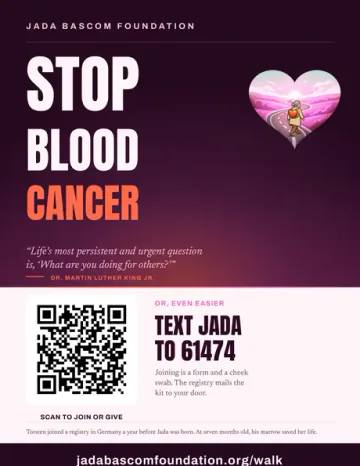
Jada Bascom was diagnosed with acute myeloid leukemia at one month old and received her transplant at seven months old from Torsten Huber, a man who had registered with DKMS at a donor drive in southern Germany, roughly five thousand miles away. No one in Jada's family was a match, and that is common: NMDP, the US registry, says 75% of patients do not have a fully matched donor in their own family. The donor who fits a given patient is often a stranger who simply decided to be in the pool — which is the entire reason not to remove yourself from it on an assumption.
Questions
Frequently asked questions
Can you donate bone marrow if you are overweight?
NMDP assesses BMI to determine donation eligibility and says underweight or overweight BMI may prevent donation when it presents a safety risk to the donor or patient. The official registry serving your country must apply its own current BMI guidance to you.
Is there a weight limit to donate bone marrow?
There is no single universal weight limit. NMDP assesses BMI, and other registries set their own current thresholds and review rules. Because the specifics vary by registry and country, the official registry serving your country applies its guidance to your individual health history.
Why does BMI matter for bone marrow donation?
NMDP assesses BMI to determine donation eligibility. NMDP's current guidance says underweight or overweight BMI may prevent donation when it presents a safety risk to the donor or patient. The official registry serving your country applies its own current guidance to you.
Does being overweight affect the quality of donated bone marrow?
NMDP's published weight guidance says underweight or overweight BMI may prevent donation when it presents a safety risk to the donor or patient. The official registry serving your country must make the individual decision under its current guidance.
Can I register for the bone marrow registry if I am obese?
Ask the official registry serving your country whether you may register. That registry sets its enrollment, sampling, and health-history steps, and being added to the pool is separate from actually donating. If you are later found to be a possible match, the official registry serving your country applies its current BMI guidance and decides whether you may donate.
Will I be turned away on donation day because of my weight?
NMDP says a person called to donate completes a health screening and physical exam before moving forward, and it assesses BMI to determine donation eligibility. The official registry serving your country explains when and how its own BMI review occurs.
Does weight loss change whether I can donate?
The official registry serving your country must decide how its current BMI guidance applies to you. This page cannot prescribe weight loss or tell you whether or when to enroll.
Can you donate if you are underweight?
NMDP says underweight BMI may prevent donation when it presents a safety risk to the donor or patient and that extremely low weight requires careful evaluation. Other registries set their own current rules, so the official registry serving your country must apply its guidance to you.
Is the BMI limit the same in every country?
No. Eligibility guidelines, including any BMI threshold, differ by registry and by country. Some registries publish a specific upper limit, others handle weight individually within the broader health review, and the exact figures shift over time. This is one reason this page avoids stating a single hard number — the registry you join is the accurate source for its own current rules.
Joining the registry is not the same as donating, right?
Correct. Registering means following the enrollment and health-history steps set by the official registry serving your country. You are only contacted if you turn out to be a possible match for a specific patient, and even then you go through further screening, can ask questions, and can decline before any donation. No commitment to donate is made simply by joining.
What to do next
Be Someone's Torsten
NMDP assesses BMI and says underweight or overweight BMI may prevent donation when it presents a safety risk to the donor or patient. Other registries set their own current rules. Follow the enrollment steps set by the official registry serving your country and let it apply its guidance to you.
The official registry serving your country sets its enrollment method, timing, cost, sample collection, and eligibility rules.

Sources reviewed
The claims on this page are drawn from the following donor-facing and medical sources.