National Minority Donor Awareness Month and the Marrow Registry

August is National Minority Donor Awareness Month. It began as an organ-donation observance and is still mostly covered that way, which means the marrow half of it goes largely unmentioned. The observance explicitly includes recruiting bone marrow, blood stem cell and umbilical cord blood donors.
The distinction is worth drawing, because marrow matching has a harder constraint than organ matching, and it produces a sharper inequality.
Why ancestry decides the odds
Solid-organ transplants are matched primarily on blood type and tissue compatibility, and those cross ancestral lines relatively often. Marrow transplants are matched on HLA markers — and HLA markers are inherited in linked sets, passed down together rather than shuffled independently.
Two consequences follow. The first is that your most likely match is someone who shares your ancestry. The second is that a registry can only offer a patient the donors it actually holds.
Put those together and the arithmetic is unavoidable. A registry assembled mostly from one set of ancestral backgrounds will serve patients from those backgrounds best, and it will keep doing so until its composition changes. Published estimates put the chance of a white patient finding a fully matched unrelated donor in the US registry at roughly 75 to 80 percent. For Black patients, estimates sit around 30 percent or lower. Hispanic, Asian and Indigenous patients fall in between, and patients of mixed ancestry can face the narrowest search of all, because their marker combinations are the least represented.
None of that is a fact about the disease. It is a fact about a database.
What is actually changing
Two things are moving at once, and it is worth not confusing them.
The first is the registry itself. Federal data from the C.W. Bill Young Cell Transplantation Program shows more than 21,200 new adult registrants from genetically varied backgrounds added in the first quarter of fiscal year 2026 alone (October to December 2025), with more than 4,400 patients searching and over 2,100 unrelated transplants facilitated. That is real movement, and it is slow by design — a registry grows one person at a time.
The second is what counts as a usable donor. Trial results published in the Journal of Clinical Oncology found that unrelated donors matched at 4/8 to 7/8 produced one-year survival comparable to the historical benchmark for fully matched donors, when graft-versus-host disease was managed with post-transplant cyclophosphamide. Fifty-nine percent of the patients in that trial were from underrepresented racial and ethnic groups. We wrote about what that changes, and what it does not.
The second development helps patients who are searching right now. The first is the only one that fixes the underlying problem.
What registering involves
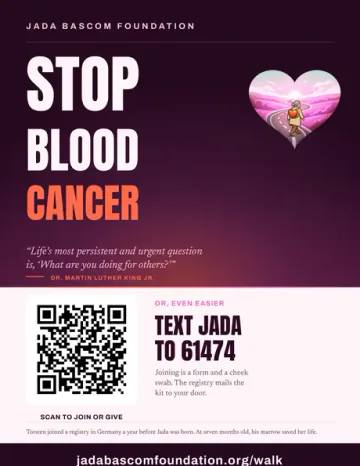
Joining a registry means a health questionnaire and a sample, often a cheek swab. Each registry sets its own rules on who can join, what it costs and how the sample is taken: in the U.S., NMDP mails a free cheek swab kit to new members aged 18 to 35. You stay listed for decades. Most people who join are never called; the ones who are called are usually contacted years later, out of nowhere, about a patient they will never meet.
If you are called and you donate, NMDP reports that about 90 percent of its donors give through the bloodstream (PBSC) rather than a surgical marrow collection — the process is described here — and NMDP does not pay donors for donating, but it covers the costs of donating, including travel and missed pay from work.
The part we will not write
You will notice this article does not tell any community what it owes anyone. Registering is not charity and it is not a favor extended to strangers by the generous. It is a peer act: people making themselves findable in case somebody with a similar genetic background needs them.
The registry is a portrait of who has joined it so far. That is the whole problem, and also the whole solution.
Editor’s note, September 2026: An earlier version of this article gave HRSA’s later year-to-date figures as first-quarter figures. We have replaced them with HRSA’s first-quarter numbers, updated the share of donations made through the bloodstream to NMDP’s current figure of about 90 percent, and corrected how we described payment to donors.
Editor’s note, October 2026: An earlier version of this article said that in most countries it is free to join a registry and the kit arrives by mail. Registries set their own rules on cost, age and how you join, so we now give NMDP’s rules for the U.S. as the example.
Share this story
Help spread awareness about bone marrow donation by sharing this article.
Related Articles



Find the registry that serves your country
The Jada Bascom Foundation does not run a registry and does not mail swab kits. We help people find the official registry serving where they live, and understand what joining actually involves.