Day 44 · Planned
Olympia — Washington State Capitol
Washington State Capitol campus, Olympia, WA
The planned walking finish at Washington’s Capitol
This day on the route
- Planned date
- The day
- Walking
- Planned walking
- 9.5 miles
Day 44: 9.5 planned walking miles to the Washington State Capitol. This is the planned walking finish, followed by the Day 45 Awareness Day; no ceremony or official reception is announced.
Route overview, not turn-by-turn directions.

The final walking stage is planned as 9.5 miles to the Legislative Building in Olympia. The campaign continues with a separate Awareness Day on Day 45.
The Legislative Building was completed in 1928 and stands 287 feet high beneath its masonry dome. Washington’s Secretary of State traces the design to Walter Wilder and Harry White, who won the 1911 competition with a plan for a group of capitol buildings. The dome became the center of a larger civic landscape rather than an isolated monument.
There is a relevant piece of public policy to read alongside that setting. RCW 41.06.570 provides qualifying employees of state executive agencies up to thirty days of paid leave in a two-year period for the life-giving procedures it defines. The statute sets scheduling and other conditions for that leave. Anyone considering donation should check the applicable rules with their employer and registry.
The itinerary assigns 9.5 planned walking miles from Madrona Beach to the Capitol. If completed as planned, this would conclude the walking portion of the route. Day 45 remains an Olympia Awareness Day with no planned route miles.
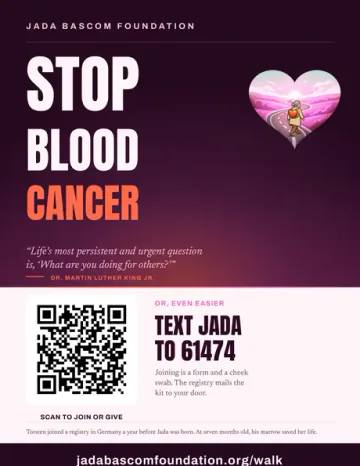
The family story that began the campaign is still the reason for its final question. Jada received marrow from Torsten Huber in Germany after he had registered before her birth. The walk asks other people to consider learning about registration through the official organization that serves where they live.
Choose where you live
Continue to the official registry that serves you. It decides eligibility, handles registration and contacts you if you may match a patient.
United States — NMDP
NMDP accepts new registry members who are 18 to 35, live in the US, its territories or freely associated states, can meet NMDP’s health guidelines, and are not already registered through another US organization. Joining happens at home: you answer a few questions on NMDP’s site, they mail you a free cheek-swab kit, and you swab and send it back. Once you are a member you stay listed until you are 61 unless you ask to be removed — 61 is when NMDP takes you off, not an age at which you can join. NMDP makes the final eligibility decision.
Check the listed age range
NMDP — Join the registry · checked Sep 1, 2026
Prefer to text? Send JADA to 61474 and NMDP will take it from there.
Browse all official registry options
Eligibility rules can change. Confirm the current requirements with the official registry before joining.
Give to the Jada Bascom Foundation
Choose a symbolic amount or enter your own in Givebutter. Your donation supports JBF’s work wherever it is needed most.
Sponsoring a mile, a day or a stop is a way of describing a gift to the Jada Bascom Foundation. It does not purchase anything on the route.
$100.00 is a suggested amount. Confirm or change it in Givebutter.
Sources
Local history and background reading for this stop.
- Legislative Building — checked Sep 5, 2026
- Legislative Building history — checked Sep 5, 2026
- RCW 41.06.570 — checked Sep 5, 2026
- Jada, Torsten and the reason for the walk — checked Sep 25, 2026