Gene therapy for sickle cell disease was approved three years ago and remains out of reach for most patients. A published cost-effectiveness analysis found stem cell transplantation the more cost-effective option for adults. Here is how the two compare, ahead of Sickle Cell Awareness Month.
Most coverage of National Minority Donor Awareness Month is about organ donation. The observance also covers bone marrow, blood stem cell and cord blood recruitment, where inherited HLA markers make the composition of the registry decide who finds a match.
Blood and marrow are on the standards in every science curriculum, and almost nothing exists to teach them well. We built sixteen lessons across four grade bands — K-2, 3-5, 6-8 and 9-12 — and they are free.
A drug given after transplant, not before, has made mismatched unrelated donors a workable option. In the NMDP-sponsored ACCESS trial, one-year survival with donors matched at 4/8 to 7/8 was comparable to the historical benchmark for fully matched donors. Here is what that does and does not mean.
Bone marrow, PBSC, and cord blood are three sources of the same blood-forming stem cells. Here is how each one works, in plain English, and why the patient's transplant team, not the donor, decides which is requested.
Black and African American patients face the longest odds of finding a matched bone marrow donor. The reason is genetic, not personal, and it is something communities can change. Here is the science behind the match gap, why it matters for blood cancers and sickle cell disease, and how to help…
Each July, Cord Blood Awareness Month shines a light on a resource that is often discarded after birth. Here is a plain-language guide to what cord blood is, the difference between public donation and private storage, who it can help, and how it connects to the marrow and stem cell registries.
Become a Potential Match
Joining a registry can make you available as a potential match for a patient who needs a transplant. JBF helps you find the official registry that serves your country.
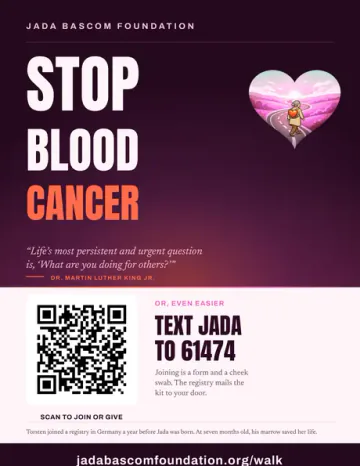
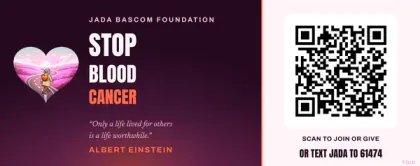
A coffee counter, a church foyer, a break room, a race table. Every sheet carries the code that opens Jeana’s walk, and a number to text for anyone who would rather not scan — no app, no wifi, nothing to hand back.Every sheet carries the code that opens Jeana’s walk — nothing to install, nothing to hand back. The number to text printed beside it is for joining NMDP, which registers people who live in the U.S., its territories and the freely associated states. If you live anywhere else, find your country’s registry.
Flyer
One page, for a wall or a noticeboard. The same sheet in three voices.
Host a registration drive at your school, work or place of worship, raise funds, or lend a skill. Tell us what you have in mind and we will help you plan it.