
AUSTRALIA · STEM CELL DONORS AUSTRALIA
Become a stem cell donor in Australia. It starts with a short online form.
For people who live in Australia. Live somewhere else? Find your country.
Stem Cell Donors Australia runs Australia’s stem cell donor registry. In 2025, 82 per cent of donations for Australian patients came from donors overseas, and people on Australia’s registry gave to patients overseas too. Here’s who can join, how it works and what happens if you’re a match.
Browsing from another country? See how joining works where you live.
How do I join?
One registry signs up people who live in Australia: Stem Cell Donors Australia. There are two ways to join it, and both start with the registry’s short online form.
Stem Cell Donors Australia
Stem Cell Donors Australia is the name used by the Australian Bone Marrow Donor Registry, a not-for-profit company and registered charity. It keeps Australia’s list of volunteer donors and searches it, and registries overseas, for patients who need a donor.
At home
17 to 35 years old to join this way
Fill in the form and the registry posts you a free cheek swab kit. Swab the inside of your cheeks and post it back.
The registry says kits may take 6 to 8 weeks to arrive at the moment.
When you give blood
18 to 35 years old to join this way
Fill in the form, book a blood donation with Lifeblood, and when you arrive tell the staff and show them your completed form. They take a small extra sample while you donate. If you’re 18 or over and want to join sooner, the registry suggests this way.
Cost. Free to join. If you’re ever asked to donate, your travel, medical and accommodation costs are covered. Donors aren’t paid.
Language. The registry’s website and form are in English.
Why we show this one. It’s the only registry that signs up people who live in Australia.
Not ways to join
Giving blood on its own. It doesn’t put you on the registry. You join with the registry’s form first.
DKMS or Anthony Nolan. Registries in other countries sign up people who live there. DKMS has no organisation in Australia.
New Zealand’s registry. It’s for people who live in New Zealand.
Who can join?
These are Stem Cell Donors Australia’s rules, in short. Its own page has the full list, and the registry decides.
- Where you live
- In Australia.
- Medicare
- A green or blue Medicare card, or being eligible for one. Permanent residents, and New Zealand citizens who live in Australia, have green cards. People who’ve applied for permanent residency or protection have blue cards. If you’re on a temporary visa without Medicare, ask the registry before you start, because its form asks about your card.
- Age to join
- 17 to 35 with a home swab kit. 18 to 35 when you give blood.
- How long you stay on the registry
- Until your 60th birthday.
- Age to donate
- From 18. If you join at 17, searches can include you once your sample has been typed, but nothing about donating starts until you turn 18.
- Your health
- Most healthy people can join. Some conditions rule it out. The registry lists them on its eligibility page.
- Things that don’t stop you
- Some things that stop you giving blood don’t stop you joining with a swab kit. The registry names having lived in the UK, travel overseas, tattoos, intravenous drug use and male-to-male sex.
- What you agree to
- To donate anonymously to any patient, in Australia or anywhere in the world, if you’re a match and still able to. Donations are always collected in Australia.
- Cost
- Free.
Stem Cell Donors Australia, Join the registry, Am I eligible? and 17-year-olds can now register. Checked .
What happens after I join?
From your sample to a possible call
Join online.
Answer three short questions, fill in the form and choose your way of joining.
Give your sample.
Swab your cheeks and post the kit back, or give a small extra sample when you give blood.
You’re on the registry.
Your tissue type is recorded under a donor number. People searching for a patient, here or overseas, see only that number and your test results, such as your tissue type.
If you might be a match.
The registry phones you, sends some health questions and arranges blood tests. The patient’s medical team then chooses the donor. From the first call to a confirmed match can take two to three months.
Getting ready.
You have a medical check at the hospital that would collect your cells. An independent specialist explains everything and checks that donating is safe for you.
Donating.
It happens in Australia, usually in a city in your own state. If you have to travel, the registry arranges and pays for it, and for a support person.
Afterwards.
The registry checks in within a few days, again after a few weeks and at three months, then once a year for ten years.
Most people who join are never asked to donate. Keep your details up to date so the registry can reach you if you are.
You can change your mind at any time. If you’re unsure, say so early. About a week before a transplant, the patient starts treatment that wipes out their own bone marrow, and from then on they depend on your donation. The registry will tell you when that point is coming.
Update your details with Stem Cell Donors Australia (opens in a new tab)
If I’m a match, how would I donate?
There are two ways to donate. The patient’s medical team asks for one or the other, and the registry explains what’s involved and supports you through it.
Blood stem cells, from your arm
About 9 in 10 donations in Australia. For four days you have injections, under the skin, of a medicine called G-CSF that moves stem cells into your blood. A nurse or GP usually helps with the first one. On day five, at a hospital, blood is drawn from one arm, a machine collects the stem cells, and the rest goes back into your other arm. It takes 4 to 6 hours. Sometimes a second day is needed. Most donors feel achy and tired for a few days, a bit like the flu. Some people feel woozy or faint afterwards, so take it easy for the rest of the day.
Bone marrow, from the back of your hip
About 1 in 10 donations, usually for children. There are no injections beforehand. Under a general anaesthetic, a doctor uses a needle to draw liquid marrow from the back of your hip bones, which takes 1 to 2 hours. Some hospitals keep you overnight. Expect a sore lower back or hips, stiffness and tiredness. Most people feel normal again within one to two weeks. Your body replaces the marrow within weeks.
The risks, plainly
Serious problems are uncommon, but they happen. In a large US study of unrelated donors, about 1 in 180 blood stem cell donors and about 1 in 40 marrow donors had one. Large studies that followed donors for years have not found a higher rate of cancer or autoimmune disease. Some blood stem cell donors need a temporary central line for the collection. Ask what that would involve.
AUSTRALIA AND THE WORLD
Australia and the world’s search
Most patients who need a stem cell transplant don’t have a matched donor in their family. About 3 in 10 patients in Australia do. Everyone else needs a stranger, and that stranger can live anywhere. These figures come from the registry and the World Marrow Donor Association. Each one says what was counted and when.
197,322
adult donor records Stem Cell Donors Australia lists with the World Marrow Donor Association
World Marrow Donor Association, data processed 12 October 2026. Records include people who may be temporarily unavailable. Checked .
About 1,300
Australian patients needed a donor from outside their family in 2025
Stem Cell Donors Australia, Our Impact. Checked .
164
people on Australia’s registry donated in 2025, for patients here and overseas
Stem Cell Donors Australia, Our Impact. Checked .
93,710
young donors in what the registry calls its ‘effective donor pool’, about a quarter more than a year earlier
Stem Cell Donors Australia, Our Impact, reported May 2026. Checked .
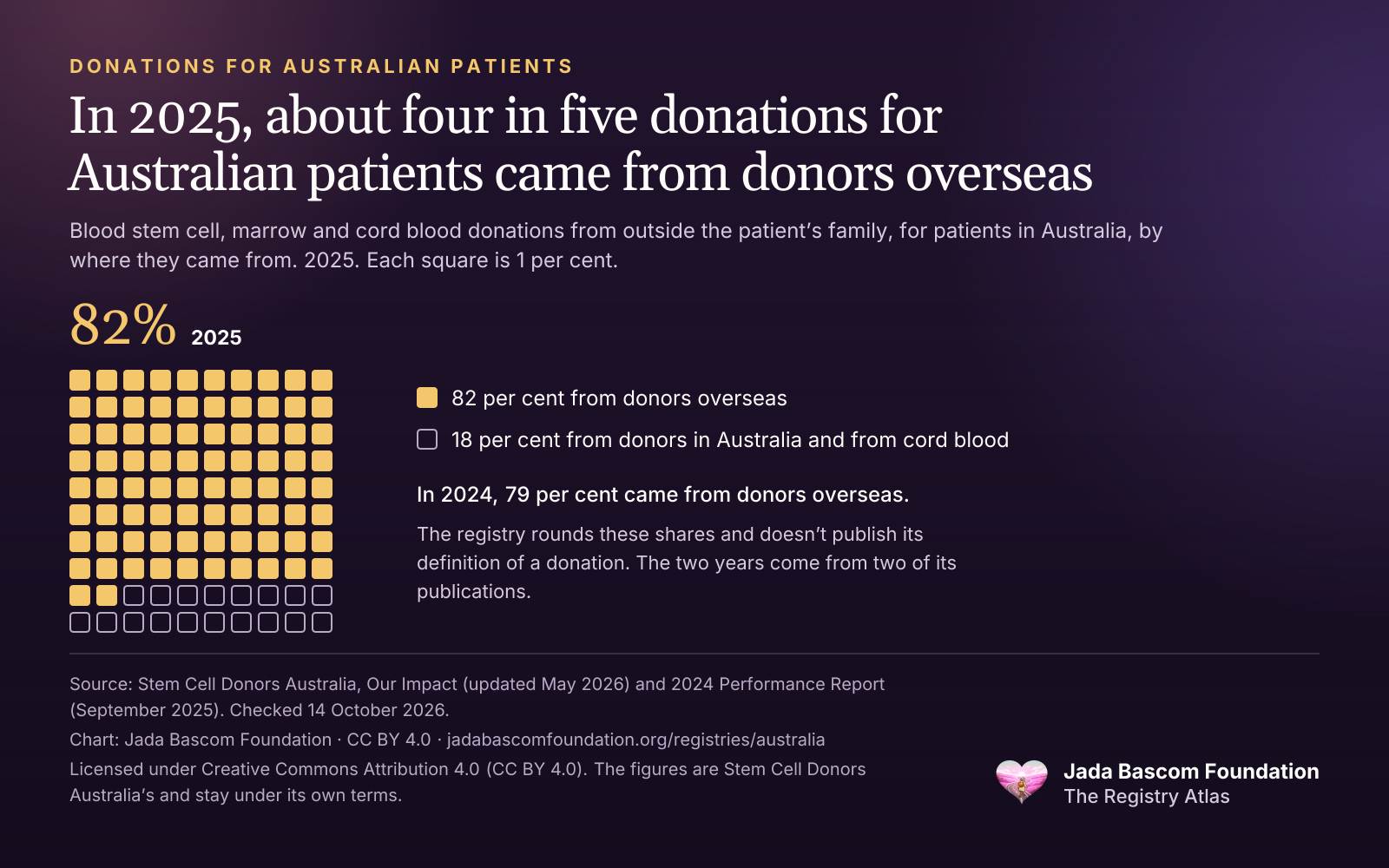
DONATIONS FOR AUSTRALIAN PATIENTS
In 2025, about four in five donations for Australian patients came from donors overseas
Blood stem cell, marrow and cord blood donations from outside the patient’s family, for patients in Australia, by where they came from. 2025. Each square is 1 per cent.
The numbers behind this chart are in a table under “Show the numbers”.
82% 2025 · from donors overseas
- 82 per cent from donors overseas
- 18 per cent from donors in Australia and from cord blood
In 2024, 79 per cent came from donors overseas.
The registry rounds these shares and doesn’t publish its definition of a donation. The two years come from two of its publications.
Our charts and data are free to reuse under CC BY 4.0 with credit to the Jada Bascom Foundation. The figures stay under their publishers’ own terms.
Show the numbers
| Year | Share of donations for Australian patients from donors overseas | Source |
|---|---|---|
| 2025 | 82 per cent | Stem Cell Donors Australia, Our Impact |
| 2024 | 79 per cent | Stem Cell Donors Australia, 2024 Performance Report |
How to cite
Jada Bascom Foundation, ‘In 2025, about four in five donations for Australian patients came from donors overseas’, The Registry Atlas, checked 14 October 2026, https://jadabascomfoundation.org/registries/australia#au-donations-by-origin-2025. Data: Stem Cell Donors Australia, Our Impact; Stem Cell Donors Australia, 2024 Performance Report: stem cell donations and transplants in Australia.
Please credit Stem Cell Donors Australia for the figures too.
That’s how the search is meant to work. When a patient needs a donor, registries around the world search together, and the best match might live on the other side of the planet. It works the other way too: in 2025, people on Australia’s registry donated for patients here and in other countries.
More patients in Australia are reaching a transplant. In 2025, 505 Australian patients received a transplant from a donor found through the registry, 47 more than the year before.
A bigger, more varied registry here still matters. Your tissue type is more likely to match someone who shares some of your background, so the more people from every background who join here, the better the chance that a patient in Australia finds a match.
Joining from anywhere in Australia
If you live far from a city.
You don’t need to travel to join. The swab kit comes by post. If you’re ever asked to donate, collection happens at a hospital in a city, usually in your own state, and the registry arranges and pays for travel and accommodation for you and a support person.
If you don’t have a Medicare card.
The registry’s form asks whether you hold a green or blue Medicare card, or are eligible for one. If Australia isn’t your long-term home, look up how joining works where you usually live, or ask the registry before you start.
If English isn’t your first language.
The registry’s website and form are in English only. We haven’t found its information in other languages.
If you’d like help with the kit or the form.
You can ask Stem Cell Donors Australia. We haven’t found published details about the help it offers, such as Easy Read or Auslan information.
Why your background matters.
Matching depends on genetic markers, so a fully matched donor is more likely to be someone who shares some of your background. The registry says its young donors broadly reflect Australia’s mix of backgrounds, but there aren’t yet enough of them for that mix to help every patient. Modelling commissioned by Stem Cell Donors Australia and released with the Leukaemia Foundation in September 2026 estimated that a patient’s chance of finding a fully matched young donor in Australasia ranges from 39 per cent to 5 per cent, depending on their ancestry. A low chance of a full match doesn’t mean there’s no donor: transplant teams can also use donors who are a partial match. More people from every background on the registry means more matches for everyone.
Show the registry’s figures
| Ancestry group (the study’s own groups) | Modelled chance |
|---|---|
| North-West European | 39 per cent |
| Aboriginal and Torres Strait Islander Peoples, Māori and Pasifika (modelled together) | 25 per cent |
| Southern and Eastern European | 19 per cent |
| Sub-Saharan African | 18 per cent |
| People of the Americas | 10 per cent |
| North-East Asian | 9 per cent |
| South-East Asian | 9 per cent |
| Southern and Central Asian | 6 per cent |
| North African and Middle Eastern | 5 per cent |
These are estimates for groups of people from a study that hasn’t been published. They aren’t a prediction for any one person.
Aboriginal and Torres Strait Islander peoples.
Stem Cell Donors Australia works with Aboriginal and Torres Strait Islander communities, Elders and community-controlled health organisations to share clear, culturally safe information about donating. Its own pages explain that work.
Read about the registry’s First Nations partnerships (opens in a new tab)
Joining from anywhere in Australia
- Anywhere with a postal address: join with a swab kit
- Christmas Island, Cocos (Keeling) Islands, Norfolk Island: still checking whether kits are posted
- Heard Island and McDonald Islands: no one lives there year-round
Australia’s external territories
- Still checking
Christmas Island: it looks like you can join through Stem Cell Donors Australia. Check one thing first.
Christmas Island - Still checking
Cocos (Keeling) Islands: it looks like you can join through Stem Cell Donors Australia. Check one thing first.
Cocos (Keeling) Islands - Still checking
Norfolk Island: it looks like you can join through Stem Cell Donors Australia. Check one thing first.
Norfolk Island Heard Island and McDonald Islands: no one lives there year-round, so there’s no registry to join.
Easy to mix up
Is giving blood the same as joining?
No. Giving blood with Lifeblood helps patients who need blood.
More about this: Is giving blood the same as joining?
It only puts you on the stem cell registry if you also fill in the registry’s form and give the extra sample when you donate. If you can’t give blood, you may still be able to join with a swab kit, and Lifeblood can talk you through your options on 13 14 95.
What about cord blood?
You may be able to donate your baby’s cord blood to a public bank, free, for any patient who needs it.
More about this: What about cord blood?
Australia has three public banks, in Sydney, Melbourne and Brisbane, known together as AusCord. Whether you can donate can depend on collection staff being available when you give birth, so ask your midwife. Storing cord blood privately for your own family is a separate, paid service, and it isn’t donation.
Can stem cells treat my injury, my illness or ageing?
Blood stem cell transplants are a proven treatment for some blood cancers and disorders of the blood and immune system, such as leukaemia.
More about this: Can stem cells treat my injury, my illness or ageing?
In Australia, that’s the only approved stem cell treatment. Some clinics in Australia and overseas advertise other stem cell treatments that haven’t been shown to be safe or effective, and they may cause harm. Joining the registry or donating doesn’t give you access to any treatment, and it won’t improve your own health.
Questions
Can I join if I’m not an Australian citizen?
Yes, if you live in Australia and hold a green or blue Medicare card, or are eligible for one. Permanent residents, and New Zealand citizens who live here, have green cards. People who’ve applied for permanent residency or protection have blue cards. The registry asks about Medicare, not citizenship. If you’re on a temporary visa without Medicare, ask the registry before you start.
I’m 17. Can I join?
Yes. Since May 2026, 17-year-olds can join with a home swab kit. Once your sample has been typed, searches can include you, but nothing about donating starts until you turn 18.
I’m older than 35. Can I still help?
You can’t join after 35. If you joined earlier, you stay on the registry until your 60th birthday. You can still help by giving blood, or by telling people aged 17 to 35 how joining works.
Does it cost anything?
No. Joining is free. If you’re ever asked to donate, the registry covers travel, medical, hospital and accommodation costs, and for a support person if you need to travel.
Do donors get paid?
No. In Australia, donors aren’t paid; human tissue laws don’t allow it. The registry doesn’t pay you for your time, but it can give you information for your employer.
I can’t give blood. Can I still join?
You may still be able to. Some things that stop you giving blood, such as having lived in the UK, travel overseas, tattoos or male-to-male sex, don’t stop you joining with a home swab kit. The registry has its own health rules, so read them first. Lifeblood can also talk you through your options on 13 14 95.
How likely is it that I’ll be asked to donate?
Most people who join are never asked. The registry says it depends on things like your age, your background and how many people are on the registry. That’s why it matters to keep your contact details up to date: if you are a match, the registry needs to reach you.
Does donating hurt, and are there long-term effects?
Most blood stem cell donors feel achy and tired for a few days. Marrow donors usually have a sore lower back or hips for a week or two. Serious problems are uncommon, but they happen: in a large US study, about 1 in 180 blood stem cell donors and about 1 in 40 marrow donors had one. Studies that followed donors for years have not found a higher rate of cancer or autoimmune disease.
How much time would donating take, and is time off work paid?
The registry says testing and donating take about 16 hours, spread over several weeks. A blood stem cell donation means four days of injections, then a collection of 4 to 6 hours. A marrow donation takes 1 to 2 hours under a general anaesthetic, sometimes with a night in hospital. Donating is free, and your costs are covered. The registry doesn’t pay you for your time, but it can give you information for your employer.
Can I choose who gets my cells, and will I meet them?
No, you can’t choose. You agree to donate anonymously to any patient, in Australia or anywhere in the world, though your donation is always collected in Australia. You and the patient can write to each other without names. After two years, if you both agree, you can ask to be put in touch, depending on the rules in the patient’s country.
What happens to my sample and my details?
Your sample is used to find your tissue type, and it may be tested in an approved laboratory overseas without your name on it. People searching for a patient see only your donor number and your test results, such as your tissue type. The registry says it uses your DNA only for matching and care, and doesn’t share it with police without your consent. Its privacy policy has the details.
What if I move overseas, or I’m already on another country’s registry?
If you move overseas for good, the registry suggests transferring to the registry where you’ll live; check with that registry first. If you’re away for a set time, you can be marked as temporarily unavailable. If you’re already on another country’s registry and now live in Australia, you don’t join again: contact Stem Cell Donors Australia with your tissue-typing report and ask to transfer.
Who pays when a patient’s donor is overseas?
For eligible patients, the Australian Government does. It funds searches of overseas registries, up to $12,000 per patient over a lifetime, and the cost of collecting and transporting cells from a donor overseas. The patient’s transplant team handles this. The programs are for people who live in Australia and hold Medicare, and the transport program also requires permanent residence.
Who is the Jada Bascom Foundation?
We’re a charity in the United States. We don’t run a registry, and we aren’t part of Stem Cell Donors Australia. We explain how joining works and help people find the official registry where they live.
Live somewhere else?
Registries sign people up by where they live, not by nationality.
Learn more
BE SOMEONE’S TORSTEN
The same search found Jada’s donor in Germany.
Jada was a baby in Spokane, Washington, when doctors found she had acute myeloid leukaemia. Her match was a stranger five thousand miles away: Torsten, who had joined the DKMS registry at a donor drive in Germany the year before she was born. Many donors for Australian patients live in Germany too. If you live in Australia, your place in that search starts with Stem Cell Donors Australia.
CHECKED BEFORE IT WAS PUBLISHED
Sources
Stem Cell Donors Australia
- Stem Cell Donors Australia. Join the registry (opens in a new tab). Updated 10 September 2026.Checked
- Stem Cell Donors Australia. Am I eligible? (opens in a new tab) Updated 28 April 2026.Checked
- Stem Cell Donors Australia. Pre-enrolment questions (cheek swab and Lifeblood routes) (opens in a new tab). Undated.Checked
- Stem Cell Donors Australia. 17-year-olds can now register as stem cell donors in Australia (opens in a new tab). 6 May 2026.Checked
- Stem Cell Donors Australia. FAQs (opens in a new tab). Undated.Checked
- Stem Cell Donors Australia. The donation process (opens in a new tab). Updated 13 August 2026.Checked
- Stem Cell Donors Australia. Donation methods (opens in a new tab). Updated 6 December 2024.Checked
- Stem Cell Donors Australia. Our Impact (opens in a new tab). Updated 25 May 2026.Checked
- Stem Cell Donors Australia. 2024 Performance Report: stem cell donations and transplants in Australia (opens in a new tab). September 2025.Checked
- Stem Cell Donors Australia. Searching for a donor (opens in a new tab). Updated 27 November 2024.Checked
- Stem Cell Donors Australia. Privacy policy (opens in a new tab). Updated 13 August 2026.Checked
- Stem Cell Donors Australia. Could a stem cell donor be linked to a crime through DNA? (opens in a new tab) March 2026.Checked
- Stem Cell Donors Australia. First Nations Community Partnerships (opens in a new tab). Updated 17 November 2025.Checked
- Stem Cell Donors Australia. Aboriginal and Torres Strait Islander Language Guide (opens in a new tab). Updated 24 March 2026.Checked
- Leukaemia Foundation and Stem Cell Donors Australia. Ancestry gap revealed: thousands of Australians face 1 in 10 chance, or less, of finding a lifesaving stem cell donor (opens in a new tab). Media release, 22 September 2026.Checked
- Australian Bone Marrow Donor Registry. Annual report for the year ended 30 June 2025 (opens in a new tab). October 2025.Checked
Government and official registers
- Australian Business Register. ABN 38 096 625 231: Australian Bone Marrow Donor Registry (opens in a new tab). Undated.Checked
- Australian Charities and Not-for-profits Commission. Register of Australian charities (open data) (opens in a new tab). October 2026.Checked
- Services Australia. Medicare eligibility; Medicare cards; Medicare for New Zealand citizens (opens in a new tab). Undated.Checked
- Department of Health, Disability and Ageing. Haemopoietic Progenitor Cell Framework and Programs (opens in a new tab). Updated 20 May 2025. Archived copy.Checked
- healthdirect Australia. Stem cells (opens in a new tab). Reviewed December 2023.Checked
- Therapeutic Goods Administration. Stem cell treatments and regulation: a quick guide for consumers (opens in a new tab). 11 September 2019. Archived copy.Checked
- Parliament of Victoria, Legislative Assembly Legal and Social Issues Committee. Register and talk about it: Inquiry into increasing the number of registered organ and tissue donors (opens in a new tab). March 2024.Checked
- Federal Register of Legislation. Australia’s territories (opens in a new tab). Undated.Checked
- Australian Antarctic Division. Heard Island and McDonald Islands (opens in a new tab). Updated 28 September 2026.Checked
Other services
- Australian Red Cross Lifeblood. Donate blood stem cells (opens in a new tab). Undated.Checked
- AusCord. About AusCord and public cord blood banking (opens in a new tab). 1 December 2025.Checked
- DKMS. Our structure (opens in a new tab). Undated.Checked
- New Zealand Blood Service. New Zealand Bone Marrow Donor Registry: FAQs (opens in a new tab). Undated.Checked
Statistics
- World Marrow Donor Association. Total number of donors and cord blood units (opens in a new tab). Data processed 12 October 2026.Checked
Research
- Pulsipher and colleagues. Lower risk for serious adverse events and no increased risk for cancer after PBSC vs BM donation (opens in a new tab). Blood, 2014.Checked
- Rüesch and colleagues. Basic characteristics and safety of donation in related and unrelated haematopoietic progenitor cell donors - first 10 years of prospective donor follow-up of Swiss donors (opens in a new tab). Bone Marrow Transplantation, 2022.Checked
- Bolan and colleagues. Donation activities and product integrity in unrelated donor allogeneic hematopoietic transplantation: experience of the National Marrow Donor Program (opens in a new tab). Biology of Blood and Marrow Transplantation, 2008.Checked
- Chowdhury and colleagues. Including HLA-mismatched unrelated donors and alternative graft sources (opens in a new tab). NMDP research abstract, 2022.Checked
About Jada
- Jada Bascom Foundation. About us: Jada’s story. Undated.Checked
Map outlines: Natural Earth. Boundaries are for orientation only and imply no position on any dispute.
Data version hub-2026.10.14-2+672e8ae2Download this page’s data (CSV)