One Million Reasons to Hope: Jada Bascom Foundation Launches Global Donor Campaign

"One million donors isn't just a number. It's one million chances for a mother to see her daughter graduate. One million chances for a child to grow old. One million reasons to hope."
The arithmetic of bone marrow donation is brutal and unforgiving.
Every three minutes, a doctor in the United States delivers a diagnosis that will change a life: leukemia, lymphoma, myeloma, or one of dozens of other blood cancers and disorders. For many of these patients — children who have not yet learned to ride a bicycle, parents who promised to walk their daughters down the aisle, grandparents with stories still untold — a bone marrow transplant represents the only realistic chance at survival.
But here is where the numbers turn cruel: according to NMDP, 75 percent of patients who need a transplant don’t have a fully matched donor in their own family. Many of them depend on the generosity of strangers — strangers who have taken ten minutes to swab their cheek and add their name to a registry.
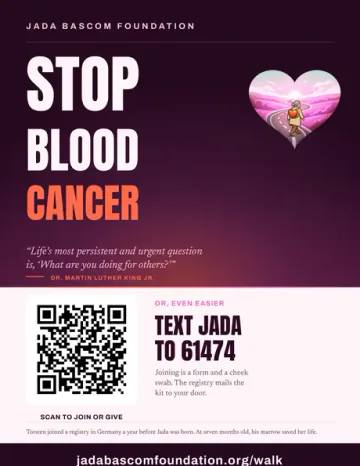
Today, the Jada Bascom Foundation announces its answer to those numbers: the One Million Donors campaign, a twelve-month global initiative to help one million new potential bone marrow donors join official registries between March 1, 2026, and March 1, 2027.
The Scale of the Challenge
The global bone marrow registry system represents one of humanity's most remarkable cooperative achievements — a network of more than 40 million registered donors, searchable across borders through the World Marrow Donor Association when a patient needs a match.
Yet for all its scope, the system remains inadequate to the need.
The problem is not merely size but diversity. Bone marrow matching relies on human leukocyte antigens, or HLA markers — genetic signatures inherited from our parents that must align between donor and recipient with extraordinary precision. The more genetically similar the donor and patient, the higher the likelihood of a match.
This biological reality creates a stark inequity. Patients of European descent find matches approximately 79 percent of the time. For patients of African, Asian, Hispanic, or mixed heritage, that number plummets — sometimes to below 30 percent.
The solution is as simple as it is urgent: more donors, from more backgrounds, in more places.
A Mission Born from Love
The Jada Bascom Foundation understands this urgency intimately.
The organization carries the name of Jada Bascom, whose life and legacy embody both the tragedy of the matching gap and the transformative power of individual action. For years, the foundation has cultivated relationships and built networks to connect potential donors with the registries serving their communities.
Jada is alive and thriving today because of the global donor pool — and because of one extraordinary man. When Torsten Huber was identified as a match and asked whether he would prefer to donate bone marrow or blood stem cells, his response was simple: "What would be better for her?"
Torsten remains the foundation's hero, beloved by all who know his story. His selfless act stands as proof of what becomes possible when one person chooses to put a stranger's needs above their own.
Building on that legacy, the foundation built a registry finder that points people to the official registry for where they live — 47 registries across 40 countries at launch, and 51 registries serving 41 countries as of September 2026 — making it easier for potential donors to take the first step.
Now, that registry finder becomes the backbone of the most ambitious donor recruitment campaign in the foundation's history.
The Campaign
Beginning March 1, 2026, the One Million Donors campaign will pursue a multi-pronged strategy designed to reach potential donors where they live, work, worship, and gather.
Community Drives: The foundation will partner with universities, corporations, faith communities, and civic organizations with the intent to host registration events in all 50 states and across six continents. Each drive will empower the global registry with the life-saving power of each individual signed up.
Digital First: A redesigned online experience will point anyone, anywhere, to the official registry for their country, where they can register and request that registry’s own swab kit. The process takes less than ten minutes.
Storytelling at Scale: The campaign will amplify the voices of donors, recipients, and families whose lives have been transformed by bone marrow donation — making the abstract concrete, the statistical personal.
Global Partnerships: Working with international registry partners, the foundation will support targeted outreach in communities historically underrepresented in donor pools, with culturally appropriate messaging and locally trusted messengers.
What Donors Need to Know
The path from potential donor to lifesaving match is simpler than most people realize.
Registration requires only a brief health questionnaire and a painless cheek swab — a process that takes roughly ten minutes and can be completed at a community drive or through a kit the registry mails to your home. In the United States, NMDP registers new members aged 18 to 35 who are in generally good health; they then stay listed until age 61 unless they ask to be removed. Registries in other countries set their own age ranges.
If called as a match — most people who join are never contacted, and Dana-Farber Cancer Institute reports that about 1 in 430 members of the U.S. registry go on to donate — the actual donation usually involves one of two methods: a peripheral blood stem cell (PBSC) donation, similar to giving plasma, which NMDP says about 90 percent of its donors give, or a surgical procedure to collect marrow from the back of the pelvic bone. Both carry some risk — NMDP reports serious complications in fewer than 1 percent of donors — and both offer the possibility of granting another human being the gift of continued life. If asked to donate bone marrow, it is often to save a child's life.
The foundation's website provides detailed information on eligibility requirements, the donation process, and the global network of registries available in each country.
The Mathematics of Hope
One million new donors will not solve the matching crisis. The genetics are too complex, the need too vast, the biological lottery too unpredictable.
But one million new donors will change the odds.
It will mean matches found for patients who would otherwise have none. It will mean children who live to become parents. It will mean parents who live to become grandparents. It will mean time — the most precious commodity any of us possess — granted to those who had been told their time was ending.
The foundation invites every eligible adult to consider a question: What would you give for the chance to save a stranger's life?
The answer, it turns out, is ten minutes and a cheek swab.
Join the Million
The One Million Donors campaign launches March 1, 2026. Official registries are open to new members now.
Visit the foundation's registry finder to find the official bone marrow registry serving your country and follow its steps to join today; that registry sends its own swab kit. Share this story with someone who might become the match another person is waiting for.
One million donors. Twelve months. A world of lives waiting to be saved.
The count begins now.
Editor’s note, September 2026: We have corrected this article. An earlier version said the ideal registry candidate is 18 to 40 and that many registries accept donors up to age 60. NMDP, the U.S. registry, now registers new members aged 18 to 35, who then stay listed until age 61. We also corrected the odds of being called to donate and how we described the risks of donating, made clear that official registries, not the foundation, handle registration and swab kits, and corrected how we described our registry finder.
Share this story
Help spread awareness about bone marrow donation by sharing this article.
Related Articles


Join the Million
Every person who joins the registry is a potential lifesaver.